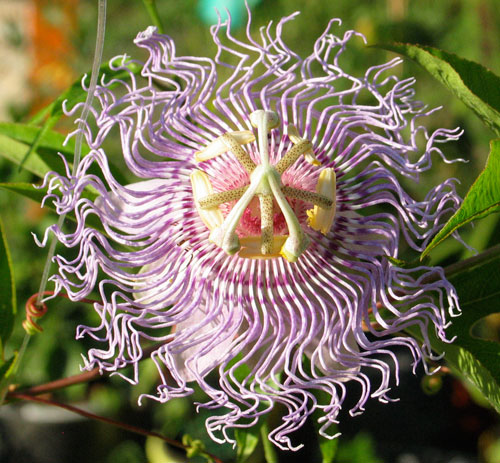
Passiflora, the passion flowers, is a large genus of predominantly tendril-bearing vines in the family Passifloraceae, with some species growing as shrubs or small trees. Named by Linnaeus in 1753, the genus currently encompasses around 550–627 accepted species (figures vary by authority), organized into four main subgenera: Astrophea, Passiflora, Deidamioides, and Decaloba. A fifth subgenus, Tetrapathaea, is recognized by some authors to accommodate Old World species.
The flowers are among the most architecturally complex in the plant kingdom. Each bloom is built on a pentamerous plan (five sepals, five petals) and bears a corona of up to eight concentric rings of colorful filaments, together with a distinctive androgynophore — an elongated stalk that bears the stamens and styles above the petals. Fruits are berry-like, typically 5–20 cm long, with arillate seeds and fragrant pulp.
The genus is overwhelmingly neotropical in origin, with its center of diversity in South and Central America, but native representatives also occur in South and Southeast Asia, across the Pacific to Fiji, Samoa, and New Zealand. Globally, species have been introduced far beyond their native ranges through cultivation and naturalization.
Common names in major languages reflect wide cultural familiarity: passionflower (English), Passionsblumen (German), passiflore (French), pasionaria (Spanish), maracujazeiro (Portuguese).
Etymology
The genus name Passiflora blends the Latin passio ("suffering") with flos/flora ("flower"). The reference is to the Passion of Jesus Christ: Spanish missionaries encountered the plants in the Americas during the 15th and 16th centuries and interpreted the flower's elaborate structures as symbols of the crucifixion story — the corona representing the crown of thorns, the five anthers recalling the five wounds, and so on. The common name "passion flower" is a direct English calque of this Latin coinage. In India the plant carries a different symbolic reading: it is called "Krishnakamala," with the 100 peripheral corona filaments representing the 100 Kaurava warriors and the 5 yellow petals the 5 Pandava heroes of the Mahabharata.
Distribution
Passiflora is predominantly a New World genus, with the great majority of its species native to tropical and subtropical regions of the Americas, ranging from the southeastern United States (Alabama) south to Uruguay and Argentina. The genus also has native species in tropical and subtropical Asia (India, China, the Philippines, Thailand) and extends into the Pacific (Fiji, Samoa, New Zealand). North American representatives include species adapted to arid conditions in Arizona and New Mexico (P. arizonica, P. arida).
Several species have naturalized well beyond their native ranges through ornamental planting and agricultural escape. Passiflora caerulea now grows wild in Spain, and P. tarminiana has become an invasive weed in Hawaii. The genus is now cultivated on every inhabited continent.
Taxonomy
Passiflora was formally described by Linnaeus in 1753 in Species Plantarum (2: 955). The accepted name is Passiflora L., with IPNI identifier urn:lsid:ipni.org:names:328300-2. POWO (Kew) recognizes 627 accepted species; GBIF records 1,047 total taxa including infraspecific entities and synonyms; Wikipedia estimates approximately 550 species. The genus is the type genus of family Passifloraceae, placed in order Malpighiales.
Thirty-five synonyms have been published, including the formerly used genus names Decaloba, Granadilla, Tacsonia, Murucuia, and Senapea, reflecting a history of splitting. Four subgenera are widely accepted (Astrophea, Passiflora, Deidamioides, Decaloba); some phylogenetic analyses support a fifth (Tetrapathaea) to contain the Old World lineage. MacDougal's 1994 monograph remains a primary reference for species-level taxonomy.
Ecology
Passiflora flowers are pollinated by a diverse array of animals: bumblebees, large carpenter bees, wasps, bats, and hummingbirds all serve as pollinators for different species. The sword-billed hummingbird (Ensifera ensifera), whose bill equals or exceeds its body in length, is the sole pollinator of 37 Andean Passiflora species whose tubes are too long for any other visitor.
The most celebrated ecological relationship in the genus is with Heliconiine butterflies (tribe Heliconiini). The larvae of these butterflies feed almost exclusively on Passiflora foliage, and the evolutionary arms race between plant and insect has driven remarkable morphological diversification in leaf shape across the genus, as well as the development of colored nubs that mimic Heliconius eggs (deterring oviposition), extrafloral nectaries that attract predatory ants, and a suite of cyanogenic glycosides and harmala alkaloids concentrated in leaves and roots rather than in the edible fruit.
Cultivation
Passion flowers are popular ornamental climbers valued for their spectacularly complex blooms and, in fruiting species, for edible produce. Most cultivated species perform best in full sun with moist, well-drained soil across a wide pH range (mildly acidic to mildly alkaline). Hardiness varies considerably: the majority of species suit USDA zones 8–11, tolerating only brief dips to about −5 °C. However, P. incarnata (maypop) is exceptionally cold-hardy, surviving to −20 °C. As a group, plants are fast-growing and can reach 10 m. They tolerate hard pruning and are best cut back in spring. Several cultivars and hybrids have received RHS Awards of Garden Merit, including 'Amethyst', P. × exoniensis, and P. × violacea.
Some vigorous species (P. caerulea in particular) are used as rootstock onto which less hardy species are grafted, imparting greater cold tolerance. Plants are highly resistant to honey fungus, which broadens their usefulness in gardens where that pathogen is present.
Propagation
Passiflora can be raised from seed or vegetative cuttings. Seeds benefit from a 12-hour warm-water soak before sowing. They are best started in late winter or early spring under warm conditions (approximately 20 °C); germination is slow and erratic, ranging from 1 to 12 months. Cuttings offer more reliable results: young shoot cuttings of about 15 cm with a heel root well in spring; leaf-bud cuttings also work in spring; mature semi-hardwood cuttings can be taken in early summer, typically rooting within about three months. Hand pollination is recommended when growing fruiting species under glass or indoors, since natural pollinators are absent.
Cultural Uses
The most economically important member is Passiflora edulis, the commercial passion fruit (maracujá), whose highly fragrant pulp is processed for juice and consumed fresh across the Caribbean, South America, Florida, Australia, and South Africa. P. quadrangularis (giant granadilla) and P. ligularis (sweet granadilla) are also cultivated for fruit in tropical regions.
Medicinally, P. incarnata (maypop) has the longest documented ethnobotanical history: Native Americans used leaf and root preparations as a sedative and anxiolytic long before European contact. The species' calming properties are recognized in modern herbal medicine, and its preparations are classified as generally recognized as safe (GRAS) as a food ingredient in the United States. Caution is warranted in pregnancy, as passion flower extracts may stimulate uterine contractions; other reported adverse effects include drowsiness and, at high doses, abnormal heart rhythms.
In psychonautic practice, harmala-alkaloid-rich Passiflora extracts are combined with DMT-containing plants as an ayahuasca analog known as "prairiehuasca." The flowers have also been deeply meaningful in religious iconography across cultures, from their Christian "Passion" symbolism in Catholic South America to their Hindu Mahabharata narrative associations in India.
Conservation
Several Passiflora species face contrasting pressures. Passiflora pinnatistipula (Chilean passion flower) is endangered due to habitat destruction in its native Andean range. On the other side of the ledger, P. tarminiana (banana passion flower) has become a serious invasive in Hawaii, where it smothers native vegetation. P. caerulea, widely planted as an ornamental in Europe, now grows wild in Spain and is considered a threat to local ecosystems. The genus as a whole is not assessed at family level by IUCN, but individual species range from endangered to invasive depending on range and context.










