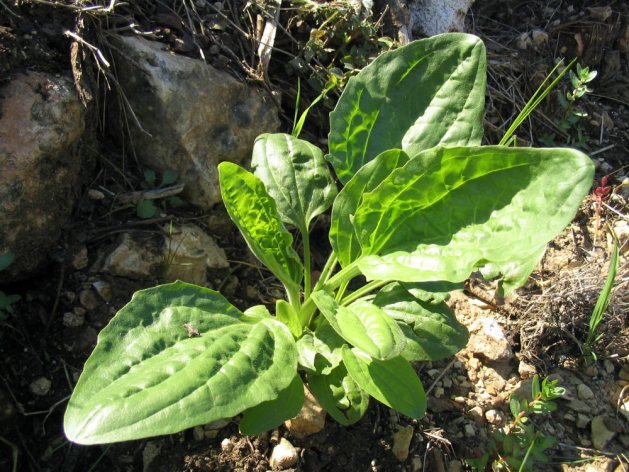
Plantago L. (plantains) is a genus of approximately 200 herbaceous plants and subshrubs in the family Plantaginaceae (order Lamiales), described by Linnaeus in 1753. Most members are low-growing perennials or annuals, forming basal rosettes of leaves that are sessile or have poorly defined petioles marked by three to five prominent parallel veins — an arrangement that inspired the Latin genus name, derived from planta ("sole of the foot") in reference to the flat, ground-hugging leaves.
Inflorescences rise on slender stalks typically 5–40 cm tall, bearing compact spikes or cones of small, wind-pollinated flowers. The genus is one of the most cosmopolitan on Earth, occurring across the Americas, Europe, Asia, Africa, Australia, and New Zealand. Many species thrive as ruderal weeds in disturbed ground, roadsides, and trampled paths, while others prefer moist habitats such as bogs, meadows, and seepages. Switzerland alone hosts 14 species, some of which are tracked under national and regional red lists.
The genus is best known through a handful of widespread species. Plantago major (greater plantain) and Plantago lanceolata (ribwort plantain) are ubiquitous Eurasian species now naturalized worldwide. Plantago ovata and Plantago psyllium are the commercial sources of psyllium husk, the bulk-forming dietary fiber sold under brand names such as Metamucil. Beyond fiber, the genus has a long ethnobotanical record: tender young leaves have been eaten raw or cooked since prehistory, and the plants appear in traditional medicine across many cultures for their reputed astringent, antimicrobial, and anti-inflammatory properties.
Taxonomically, Plantago is placed within Plantaginaceae alongside genera formerly given their own family. The genus encompasses several recognized subgenera — Plantago, Coronopus, Bougeria, Psyllium, and Littorella — though whether the Andean genus Bougueria and the aquatic genus Littorella should be folded into Plantago remains an open question. GBIF records 454 total taxa under the genus key.
Etymology
The genus name Plantago is classical Latin, formed from planta — meaning "sole of the foot" — combined with the suffix -ago (meaning "a sort of"). The name alludes to the characteristic flat, ground-hugging leaf rosettes that resemble a footprint pressed to the soil. Linnaeus formalized the genus in his Species Plantarum of 1753, applying the ancient Latin term that had long been used for these plants in European herbal traditions.
Distribution
Plantago is among the most widely distributed flowering plant genera on Earth. Species are native to or naturalized across all inhabited continents — the Americas, Europe, Asia, Africa, Australia, and New Zealand. The genus tolerates a broad range of climates and substrates, with many species thriving as cosmopolitan weeds in disturbed habitats: roadsides, trampled paths, cultivated fields, and waste ground. Others show more specific habitat preferences, gravitating toward wet environments such as bogs, seepages, and seasonally flooded meadows.
Within Europe, Switzerland records 14 species including P. alpina, P. lanceolata, P. major, P. media, and P. coronopus. Mediterranean species such as P. psyllium are native to southern Europe and favor dry, well-drained soils. The broad geographic range of the genus reflects both its native diversity and the unintentional human spread of weedy species along trade and settlement routes.
Ecology
Most Plantago species are wind-pollinated and many are self-fertile, flowering from spring through autumn depending on species and region. The leaves serve as larval food plants for numerous Lepidoptera (butterflies and moths), making plantains an ecologically significant component of temperate meadow and ruderal communities.
Habitat preferences vary by species. Generalist taxa occupy highly disturbed environments — compacted soil, roadsides, lawns — while others are restricted to specialized habitats such as alpine grasslands (P. alpina in the Swiss Alps), coastal sands, or wetlands. The genus's tolerance of trampling and mowing has made many species persistent in grazed pastures and turf, where their flat rosettes escape cutting blades.
Cultivation
Plantago species are generally undemanding in cultivation. They tolerate a wide range of soil types — light, medium, or heavy — and a broad pH range from mildly acidic to alkaline. Most prefer full sun but will grow in partial shade. Moisture requirements vary by species: some thrive in dry to moderately moist conditions, others prefer reliably moist soils.
In horticulture, Plantago is rarely grown ornamentally, though some variegated and purple-leaved cultivars of P. major are occasionally used as foliage plants. The genus is more often encountered as an uninvited component of lawns and borders. For seed crops (psyllium production), annual species are sown in spring after frost risk has passed, either via indoor cold-frame starts followed by outdoor transplanting, or by direct sowing in mid-to-late spring.
Propagation
Propagation is primarily by seed. For annual and short-lived species grown for their seed yield, sowing indoors in a cold frame in early spring and transplanting individual seedlings outdoors once large enough to handle is reliable. Where seed is plentiful, direct sowing outdoors in mid-to-late spring is equally effective. Perennial species in the genus will also self-seed freely under garden conditions and may spread by vegetative means via offshoots of the basal rosette.
Cultural Uses
Plantago has been used by humans for food and medicine since prehistoric times. Archaeological evidence from California's Central Coast documents use during the Millingstone Horizon period. Tender young leaves of broad-leaved species such as P. major can be eaten raw in salads; older leaves are cooked as a vegetable or added to sauces. Edibility is modest — leaves are nutritious but somewhat fibrous and mild in flavor.
Medicinally, the genus has a long global record. Preparations have been applied for their reputed astringent, antimicrobial, and anti-inflammatory properties, used topically on wounds and skin irritations in Eastern European folk medicine. The genus is also referenced in the Anglo-Saxon "Nine Herbs Charm," one of the earliest recorded European herbal texts.
The most commercially significant use is psyllium fiber, derived from the seed husks of P. ovata and P. psyllium. The husks contain approximately 30% mucilage, which absorbs water and swells in the digestive tract to act as a gentle bulk laxative. Psyllium is the active ingredient in products such as Metamucil and is widely used for managing constipation and supporting digestive health.
Conservation
Conservation status varies widely across the genus. Many species are abundant cosmopolitan weeds with no conservation concern. However, Info Flora records that certain Swiss and European Plantago species carry designations on the Swiss National Red List (2016) and Regional Red Lists (2019), indicating that range-restricted or habitat-specialist species face local pressures — likely from agricultural intensification, habitat drainage, and grassland abandonment. Species-level IUCN assessments are not comprehensively available for the genus as a whole.
Taxonomy Notes
Plantago L. was established by Linnaeus in Species Plantarum (1753) and is the type genus of Plantaginaceae. The family, formerly treated as a small isolated group, is now understood within the large order Lamiales (class Magnoliopsida, phylum Tracheophyta). The genus encompasses several subgenera: Plantago, Coronopus, Bougeria, Psyllium, and Littorella. The name Psyllium Mill. is treated as a synonym of Plantago.
An ongoing taxonomic question concerns the placement of two peripheral groups: Bougueria (a monotypic Andean genus) and Littorella (small aquatic plants of the Northern Hemisphere), which some treatments absorb into Plantago and others maintain as distinct. GBIF recognizes Plantago L. (usage key 3189695) as an accepted genus with 454 total descendant taxa. Wikipedia estimates approximately 200 accepted species, reflecting the difference between accepted species and total infraspecific and synonym records.










