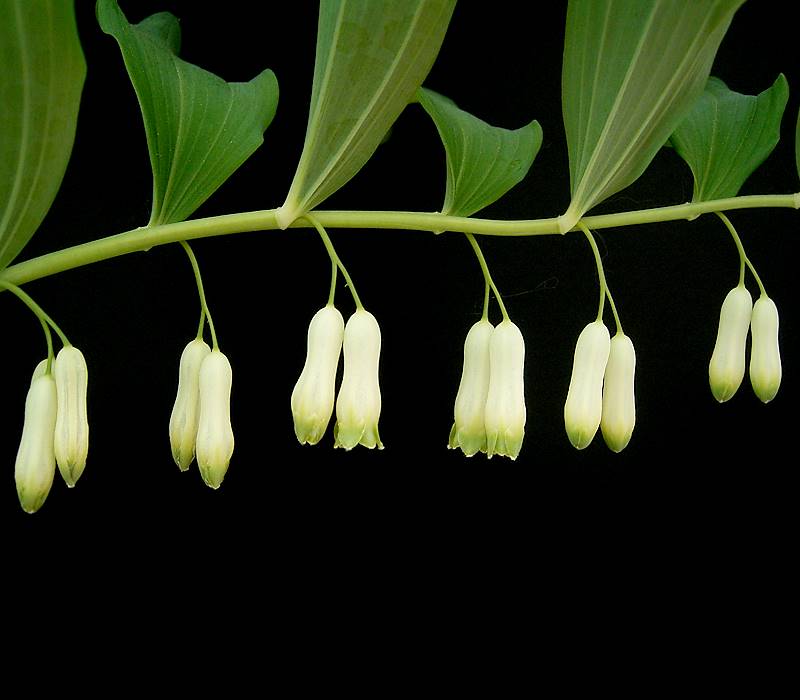
Polygonatum, commonly known as Solomon's seal, is a genus of rhizomatous herbaceous perennials in the family Asparagaceae (subfamily Convallarioideae). The genus name derives from the ancient Greek for "many knees," a reference to the characteristically knotty, jointed rhizomes that crawl horizontally through the soil. The common name "Solomon's seal" reflects either the ring-shaped scars left on the rhizome after each season's stem falls — said to resemble royal wax seals — or, in another tradition, a resemblance of cut rhizome cross-sections to Hebrew characters.
Plants are elegant in habit: stems are unbranched and either erect or gently arching, carrying alternate leaves with prominent parallel venation arranged in two ranks. Depending on species, plants range from dwarf ground-hugging forms to stately specimens reaching nearly two meters tall. In late spring, slender tubular flowers hang in pendulous clusters from the leaf axils in shades of white to pale yellow-green. Pollination relies on bees whose vibrations — buzz pollination — dislodge pollen from the pendulous tubes. By autumn the flowers give way to dark blue-black or occasionally red berries, which are ornamentally attractive but toxic to humans, containing anthraquinone compounds.
The genus encompasses somewhere between 50 and more than 60 accepted species (figures vary by authority), the majority native to Asia, with around 20 endemic to China and a handful native to Europe and North America. As a group they occupy cool, shaded deciduous woodland and forest understories across the temperate Northern Hemisphere, tolerating deep shade and moist, humus-rich soils with ease. They are widely grown in shade gardens for their graceful arching stems, long-lasting foliage, spring flowers, and fall berry display.
Etymology
The genus name Polygonatum derives from the ancient Greek words for "many" and "knee," describing the conspicuously jointed, multi-noded rhizome that gives the plant its characteristic segmented underground stem. The English common name Solomon's seal has two competing explanations: one holds that the circular scars left on the rhizome where each year's stem breaks off resemble the impression of a royal wax seal, while the other suggests that cross-sections of the cut rhizome bear a resemblance to Hebrew letters or characters associated with the seal of King Solomon.
Distribution
Polygonatum is distributed throughout the temperate Northern Hemisphere. The center of diversity lies in Asia, where the majority of species occur; approximately 20 species are endemic to China alone. A modest contingent of species is native to Europe — including P. multiflorum, P. odoratum, and P. verticillatum, all of which are documented in Switzerland — and several species inhabit eastern North America, ranging from New Brunswick and Michigan south to Tennessee and Florida. The genus is absent from tropical regions and the Southern Hemisphere.
Ecology
Solomon's seals are woodland plants adapted to cool, moist, humus-rich soils in shaded forest understories. They tolerate deep shade — conditions with less than two hours of direct sunlight daily — and perform best in soils that are organically rich and consistently moist but well-drained. In nature they occupy dry to moist sandy, loamy, or rocky deciduous woods and thickets, typically in upland areas. Once established, plants show considerable resilience, tolerating temporary drought, wet spells, and erosion-prone slopes.
Pollination is accomplished by bees through buzz pollination (sonication): the pendulous perianth tubes, which enclose both anthers and style, require the vibration produced by foraging bees to release pollen effectively. This mechanism is considered an essential feature of the genus's reproductive system.
Cultivation
Polygonatum species are valued shade garden plants, well suited to woodland gardens, naturalized areas under trees, rain gardens, and as components of cut-flower arrangements. They thrive in hardiness zones 3–9 and require fertile, humus-rich, moisture-retentive soil in cool shade. Heat and prolonged drought are poorly tolerated, though established plants handle brief dry periods. Young shoots are vulnerable to slug damage.
Flowering occurs in late spring to early summer (May–June); the flowers carry a faint lily-like fragrance. The pendulous dark blue-black berries that follow provide ornamental interest into autumn. Notable ornamental selections include P. × hybridum (garden Solomon's seal), P. odoratum 'Variegatum' and 'Goldilocks', and the dwarf P. humile.
Propagation
The most reliable method of propagation is division of the rhizome, carried out in March or in October. Smaller divisions should be potted and grown on before transplanting to their final position. Seeds can be sown in early autumn in a cold greenhouse, but germination is slow and erratic; this method is better suited to species conservation or large-scale production than to home garden propagation. Root cuttings are also cited as a viable technique.
Cultural uses
Polygonatum species have a long history of human use across Asia, Europe, and North America.
In East Asia, particularly in China, the rhizomes and young shoots of species such as P. sibiricum have been used as food for centuries. Young shoots are eaten raw or cooked and served as a side dish, comparable to asparagus. Rhizomes are rich in starch, which can be extracted to supplement flour or thicken soups; they are also prepared as tea, infused into wine, or made into sweet confections. The dried rhizome, known in Chinese medicine as huangjing (黄精) or rhizoma polygonati, is a traditional tonic used to strengthen the organs and is prescribed for fatigue and weakness. P. cyrtonema rhizome preparations have been used in traditional Chinese medicine for depression and post-traumatic stress. Medicinal use of the genus for diabetes management is documented in the ethnobotanical literature from at least the early twentieth century.
In Europe and North America, Indigenous peoples including the Cherokee, Chippewa, Iroquois, and Menominee used Polygonatum species as analgesics, stimulants, and treatments for dermatological, gastrointestinal, gynecological, and cathartic needs. The roots were dried and ground into flour or cooked like potatoes during food scarcity. In folk medicine across both continents, root tea was prepared as a laxative and taken for indigestion, lung ailments, rheumatism, and skin irritations; poultices of fresh root were applied to wounds, bruises, and sores. P. verticillatum holds a place in Ayurvedic medicine as an aphrodisiac and treatment for pain and inflammation.
The berries and seeds of all species should be considered toxic and are not used for food; the anthraquinone compounds they contain cause vomiting and diarrhea.
Taxonomy notes
Polygonatum was established by Philip Miller and published in the fourth abridged edition of Gardeners Dictionary in 1754 (Gard. Dict. Abr. ed. 4). The genus has passed through several family placements over its taxonomic history, having been included in Liliaceae and later Convallariaceae before being assigned to Asparagaceae subfamily Convallarioideae under modern molecular phylogenetic classifications.
Numerous historical synonyms exist for Polygonatum, reflecting past attempts to subdivide or rename the group: Axillaria Raf., Campydorum Salisb., Codomale Raf., Evallaria Neck., Periballanthus Franch. & Sav., Salomonia Heist. ex Fabr., Sigillum Montandon, Siphyalis Raf., and Troxilanthes Raf. are all treated as synonyms under current taxonomy.
Species counts vary among authorities: GBIF records 142 descendant taxa (including infraspecific entities), Wikipedia cites approximately 63 species, and SEINet approximately 50, likely reflecting differences in species circumscription and treatment of infraspecific taxa.










