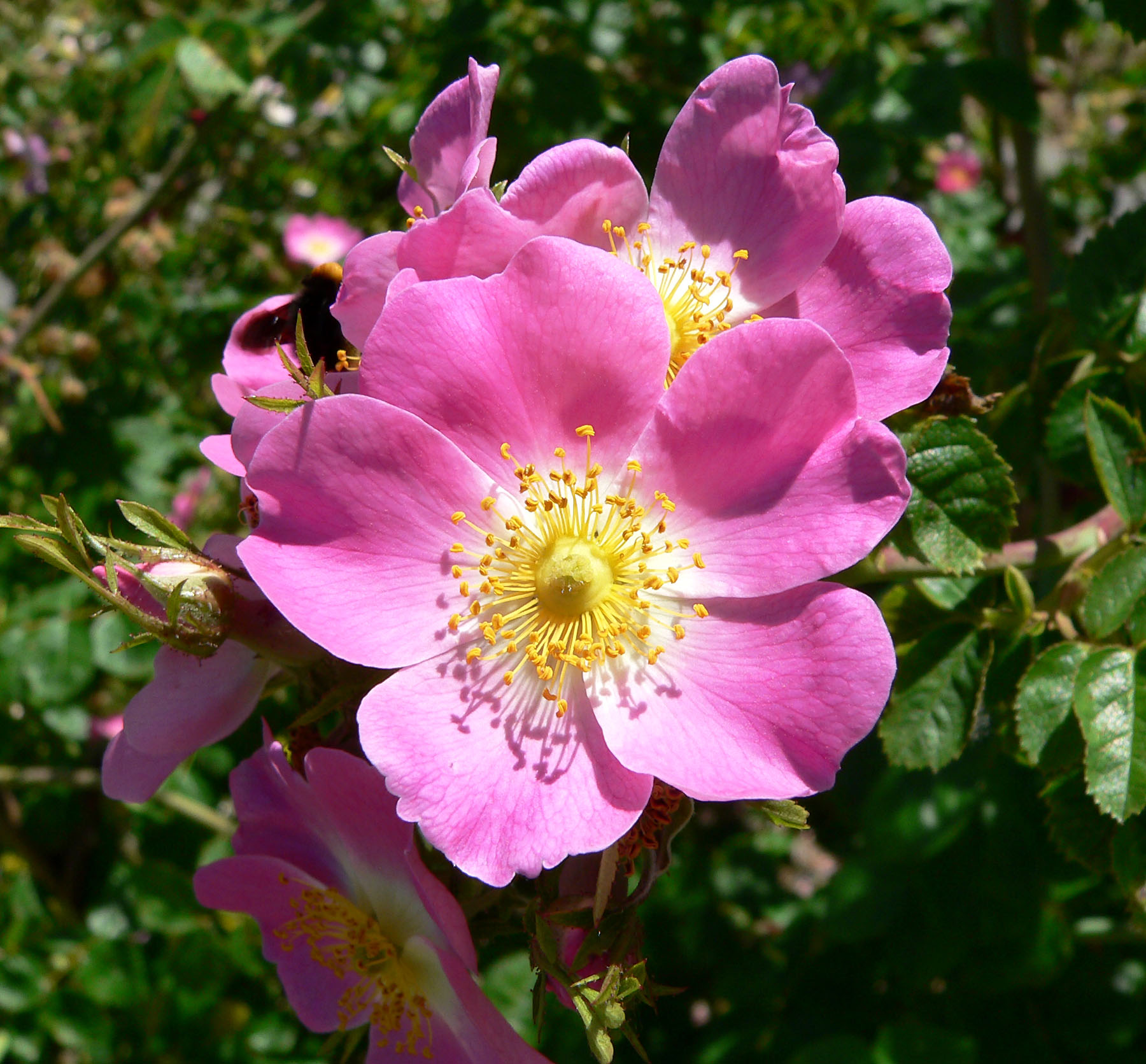
Rosa is a genus of woody, perennial flowering plants in the family Rosaceae, encompassing over 300 species and tens of thousands of named cultivars. Plants typically grow as deciduous shrubs or, in some species, as climbing or trailing vines, ranging from compact specimens under one metre to climbers reaching seven metres in height. Stems are armed with prickles — epidermal outgrowths that differ structurally from true thorns — a characteristic that distinguishes the genus at a glance.
Flowers are a defining feature of the genus: they bear petals in multiples of five, most often in shades of white, pink, red, orange, or yellow, and are followed by fleshy, berry-like fruits known as hips. The genus is divided into four subgenera — Hulthemia, Hesperrhodos, Platyrhodon, and Rosa — collectively comprising 140–180 species in current taxonomic treatments.
The genus spans the temperate and subtropical Northern Hemisphere: the majority of wild species originate in Asia, with smaller contingents native to Europe, North America, and Northwest Africa. In Europe alone, more than 40 species have been recorded, including both native taxa and naturalised introductions.
Beyond their ornamental prominence, roses carry enormous cultural weight: rose oil distilled from petals underpins much of the global perfume industry, while rose water features in Middle Eastern, Persian, and South Asian cuisines. The fruit — rich in vitamin C — has long been harvested for jellies, jams, teas, and traditional medicines across many cultures.
Etymology
The genus name Rosa derives from Latin rosa, which was itself likely borrowed into Latin from Oscan, and traces ultimately to ancient Greek rhódon. Linguistic analysis connects rhódon to Old Persian wrd- (reconstructed as wurdi), suggesting a common origin across languages of the ancient Near East and Mediterranean world. The Latin form was established as the scientific genus name by Linnaeus and has been conserved ever since.
Distribution
The genus Rosa is native to the temperate and subtropical Northern Hemisphere. The greatest diversity of wild species occurs in Asia, particularly in the Himalayas, China, and adjacent regions. Smaller numbers of native species are found in Europe, North America, and the northwest of Africa. The genus is entirely absent from the Southern Hemisphere in its native range.
In Europe, more than 40 species occur in Switzerland alone, reflecting the high richness across the continent; these include widespread species such as Rosa canina (dog rose) and montane specialists such as Rosa pendulina (alpine rose). Several species — notably Rosa multiflora from East Asia — have been introduced widely outside their native ranges and have become naturalised or locally invasive in Europe and North America.
Taxonomy
Rosa L. is the type genus of the family Rosaceae within the order Rosales. The type species is Rosa cinnamomea. The genus is currently circumscribed to contain 140–180 accepted species arranged in four subgenera: Hulthemia (monotypic, lacking stipules), Hesperrhodos (North American species with glandular leaflets), Platyrhodon (with flaking bark), and the core subgenus Rosa which contains the majority of species including all major cultivated lineages. Over 300 species names have appeared in the literature, but many are synonyms or represent natural hybrids; the genus is notoriously complex taxonomically due to extensive hybridization, polyploidy, and apomixis, which complicates species delimitation.
Ecology
Roses occupy a range of habitats from forest margins, hedgerows, and rocky slopes to wetland edges. Many species tolerate acidic soils and grow in thickets on rocky terrain. In managed landscapes, roses are susceptible to a suite of insect pests — including Japanese beetles, rose aphids, rose chafers, and rose sawflies — and to fungal diseases such as powdery mildew, botrytis, leaf spots, and anthracnose. Browsing by white-tailed deer and rabbits is also documented. Some introduced species, especially Rosa multiflora, behave as invasive shrubs in regions where they have no natural controls, forming dense thickets that displace native vegetation.
Cultivation
Roses perform best in full sun with organically rich, well-drained, acidic to neutral soil. Most garden roses require yearly pruning in late winter to maintain vigour and shape. Spent blooms should be removed (deadheaded) throughout the season to encourage repeat flowering, though deadheading should cease toward summer's end to allow the plant to begin hardening off before winter. Hardiness varies considerably across the genus: some species tolerate extreme cold down to -40°C, while tender cultivars require protection in cold climates. Rose hips are ornamentally valuable in autumn and winter, and many gardeners allow hips to develop on once-flowering species.
Propagation
The standard commercial propagation method for roses is grafting, which ensures uniform performance of named cultivars and vigorous rootstock. Seed propagation is possible for species roses but requires stratification (a period of cold and moist conditions) to break dormancy; seedlings from cultivars will not breed true. Vegetative alternatives include hardwood or semi-ripe cuttings taken at appropriate seasons, and layering — particularly useful for species with long, flexible stems. When propagating from seed, the irritating hairs attached to rose seeds should be handled with care to avoid mouth and digestive irritation.
Cultural Uses
Roses have been cultivated and used by humans for millennia across cultures. The petals of Rosa damascena and related oil roses are the source of rose otto (attar of roses), produced by steam distillation and used as one of the most prized ingredients in the global perfume industry. Rose water — a by-product of distillation — features prominently in Middle Eastern, Persian, and South Asian cooking, appearing in sweets, beverages, and savoury dishes.
The fruit (hips) are rich in vitamin C (up to 7% by dry weight in some species) and have long been harvested for jellies, jams, syrups, teas, and soups. Petals are edible raw (with the bitter white base removed), and young spring shoots can be peeled and eaten. Seeds contain vitamin E but must be carefully separated from the irritating seed hairs. An orange dye can be extracted from the hips.
In traditional medicine, various parts of the rose — roots, bark, leaves, and fruit — have been used as astringents and in preparations for coughs, eye complaints, and fever. Rose hips are under investigation for potential cancer-preventive properties. Culturally, the rose has been associated with love, beauty, and the divine across multiple traditions: ancient Greeks linked it to Aphrodite, and Christian iconography associates it with the Virgin Mary. The rose remains one of the world's most widely recognised symbols.
Conservation
Most wild Rosa species are not globally threatened, and the genus as a whole has no special listing in the IUCN Global Invasive Species Database at genus level. However, certain regionally restricted or alpine species attract conservation concern in national red lists: in Switzerland, for example, Rosa foetida and some alpine endemics are listed under red list programmes. Conversely, introduced taxa such as Rosa multiflora and Rosa rugosa are regarded as invasive in parts of Europe and North America, where they can displace native flora and alter habitat structure.










