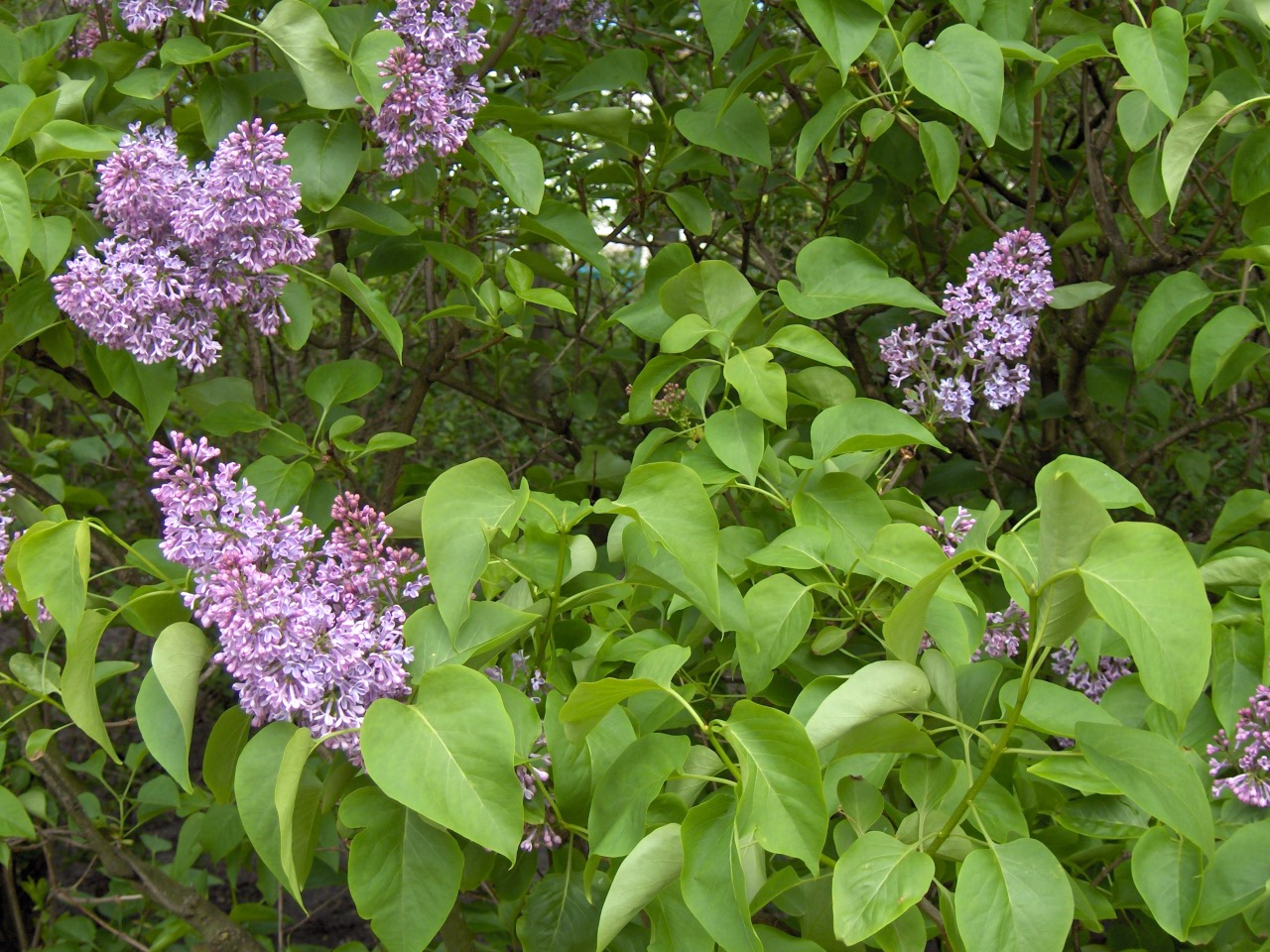
Syringa, commonly known as lilacs, is a genus of small deciduous trees and shrubs in the olive family Oleaceae. The genus comprises roughly 12 accepted species, native to woodland and rocky scrub from southeastern Europe across to eastern Asia. Plants typically reach 2–10 metres in height, with opposite, simple leaves that are heart-shaped to broadly lanceolate in form.
The hallmark of the genus is its profuse spring flowering. Flowers are small — typically 5–10 mm across — with a characteristic four-lobed tubular corolla and are borne in large, showy panicles. Colors range from the familiar lilac-purple to white, pale yellow, pink, and deep burgundy, depending on species and cultivar. Pollination is carried out by bees and Lepidoptera, and the plants are noted for attracting butterflies and moths. Fruits are dry brown capsules that split at maturity to release two winged seeds.
Syringa vulgaris, the common lilac, is the best-known species and the state flower of New Hampshire, USA. It is native to the Balkans and has been cultivated for centuries, giving rise to a large number of named cultivars. Other notable species include S. reticulata (Japanese tree lilac), S. oblata (early lilac), S. emodi (Himalayan lilac), and S. villosa, as well as a range of widely grown hybrids such as S. ×prestoniae (Preston lilac) and S. ×chinensis (Rouen lilac).
In cultivation, lilacs are prized ornamentals across temperate gardens worldwide. They prefer full sun and well-drained, neutral to alkaline soils, thriving particularly on chalk. They dislike acid soils and shade. Most species are hardy to USDA zones 3–7 and flower on old wood, so pruning immediately after flowering maintains the best display. Beyond horticulture, Syringa species have a history of use in traditional medicine across Asia for treating cough, diarrhea, hepatitis, and bronchitis, and the flowers yield an essential oil valued in perfumery.
Etymology
The genus name Syringa derives from the Ancient Greek word syrinx, meaning "pipe" or "tube," a reference to the hollow branches of Syringa vulgaris that were historically fashioned into pipes and flutes. In Greek mythology, Syrinx was a naiad nymph transformed into hollow water reeds, from which the god Pan crafted his pan pipes — a story reflected in the genus name.
The common English name "lilac" came into use through French, borrowed in turn from Arabic lilak, which itself traces back to Persian nilak or lilanj, words associated with the color indigo or blue. This etymological path reflects the characteristic lilac-blue color of the most familiar species.
Distribution
Syringa is native to a broad arc from southeastern Europe through Central Asia to eastern Asia. Syringa vulgaris originates from the Balkans (southeastern Europe) and is the species most widely naturalized beyond its native range. Other species are distributed across the Himalayan region (S. emodi), Central Asia (S. persica), China (S. oblata, S. reticulata, S. komarowii, S. pinnatifolia, S. tomentella), and eastern Russia, Korea, and Japan (S. reticulata). The genus as a whole favors woodland margins, rocky scrub, hedges, and thickets. Syringa vulgaris has been documented in Switzerland and is widely cultivated and naturalized across temperate North America, Europe, and parts of Asia.
Taxonomy
Syringa was formally described by Carl Linnaeus and published in his Species Plantarum in 1753 (page 9). The genus sits within the family Oleaceae, tribe Oleeae, subtribe Ligustrinae. Its closest relative among the Oleaceae is Ligustrum (privet), with which it shares several morphological features.
GBIF recognizes Syringa L. as an accepted genus (usageKey 3172235) in the order Lamiales, class Magnoliopsida, phylum Tracheophyta. The GBIF database records approximately 72 descendant taxa including synonyms and hybrids. Around 12 species are currently recognized. Accepted species include S. vulgaris, S. emodi, S. josikaea, S. komarowii, S. oblata, S. persica, S. pinetorum, S. pinnatifolia, S. pubescens, S. reticulata, S. tomentella, and S. villosa, along with numerous named hybrids (S. ×chinensis, S. ×prestoniae, S. ×josiflexa, S. ×nanceiana, and others).
Ecology
Syringa species typically grow in rocky scrub, hedgerows, woodland margins, and thickets. They are adapted to well-drained to moderately moist soils and prefer neutral to alkaline conditions, doing poorly on acid substrates. Flowers are produced in spring (typically May for S. vulgaris) and are hermaphroditic, pollinated primarily by bees and Lepidoptera. The plants are noted for attracting butterflies and moths and are valuable for pollinators in temperate gardens. Seeds are winged and dispersed by wind. Despite some naturalization outside their native ranges, no Syringa species appear in the IUCN Global Invasive Species Database.
Cultivation
Lilacs are among the most widely grown ornamental shrubs in temperate gardens. They perform best in full sun — shade significantly reduces flowering — in well-drained, neutral to alkaline soils including chalk. They tolerate a range of soil textures from light sandy to heavy clay, but consistently perform poorly in acid conditions. Most species and cultivars are cold-hardy to USDA zones 3–7 (UK zone 5 for S. vulgaris), making them valuable garden plants in continental climates with cold winters.
Lilacs bloom on old wood, so the critical pruning rule is to prune immediately after flowering, never in late summer or autumn when next year's flower buds have already formed. Deadheading spent panicles encourages energy allocation to new growth rather than seed production. They can be used as informal hedges or specimen shrubs, and the rootstock of S. vulgaris is sometimes used for grafting ornamental cultivars.
Propagation
Syringa can be propagated by several methods. Seeds should be sown in spring (around March) in a cold frame; stratification improves germination rates. Vegetative propagation is generally preferred for named cultivars to preserve characteristics. Softwood cuttings of young shoots (approximately 7 cm with a heel) taken in June root well; semi-ripe cuttings of half-ripe wood taken in July or August are also effective. Layering in spring is reliable but slow, typically taking around 12 months to produce a rooted layer ready for separation. Division of suckers in late winter is another option for species that produce them freely, including S. vulgaris. Many ornamental cultivars are commercially grafted onto S. vulgaris rootstock.
Cultural & Traditional Uses
Lilacs have a range of cultural, medicinal, and economic uses documented across their native and cultivated range. In traditional Asian medicine, various Syringa species have been used to treat cough, diarrhea, hepatitis, and bronchitis. For S. vulgaris specifically, leaves and fruit have been used as an antiperiodic (against recurring fevers), febrifuge, tonic, and vermifuge, and bark or leaves were chewed to treat sore mouth conditions.
The flowers are edible and can be eaten raw or prepared as fritters. Essential oil distilled from the flowers has a long history of use in perfumery. Dyes can be extracted from various parts of the plant: green from the flowers, green to brown from the leaves, and yellow-orange from the twigs.
Culturally, lilacs are strongly associated with spring and have deep symbolic significance in the English-speaking world. They are linked with first love and remembrance. Walt Whitman's elegy "When Lilacs Last in the Dooryard Bloom'd" used the lilac as a central symbol of mourning for Abraham Lincoln. Syringa vulgaris is the state flower of New Hampshire, USA. Numerous North American communities hold annual lilac festivals, and the plant is a widespread emblem of spring.
Conservation
No Syringa species are listed in the IUCN Global Invasive Species Database, indicating the genus is not considered a significant invasive threat at the global level. Individual species within their native ranges vary in abundance; no species-level IUCN Red List data was returned for the genus as a whole from the sources consulted. The genus is in widespread cultivation worldwide and S. vulgaris in particular is extremely common in temperate horticulture, with no conservation concern for the species.










