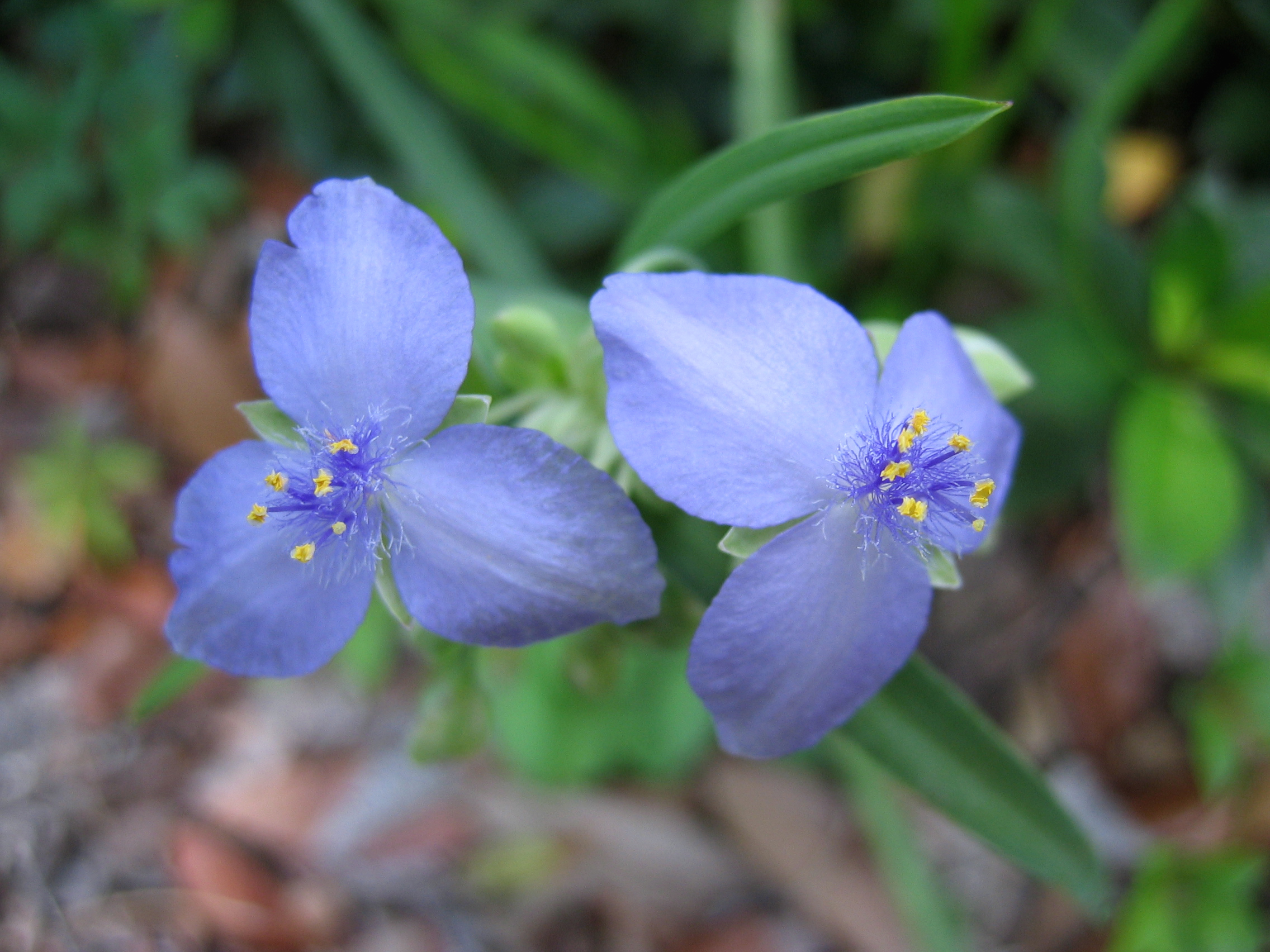
Tradescantia is a genus of 85–86 herbaceous perennial plants in the family Commelinaceae, native to the Americas from southern Canada through Mexico, Central America, and into South America. Plants produce somewhat succulent stems with fleshy, often mucilaginous leaves that range in color from green to purple to variegated silver. Flowers are small and three-petaled, appearing in white, pink, purple, or blue, with six contrasting yellow anthers; individual blooms are ephemeral and last only a single day, though flowering continues over a period of four to six weeks. When a stem is cut, the sticky sap dries into web-like threads — the origin of the common English name "spiderwort."
The genus spans a remarkable range of forms: cold-hardy prairie natives such as T. virginiana and T. ohiensis grow outdoors in temperate gardens, while tropical species like T. zebrina and T. spathacea are popular trailing or rosette-forming houseplants worldwide. Several species — most notably T. fluminensis — have naturalized far beyond their native range and are considered invasive in Australia, New Zealand, and parts of the southern United States, where they spread readily from discarded stem fragments. Stamen hairs of certain Tradescantia species are used in scientific research as a bioassay for ionizing radiation and chemical pollutants, with blue cells mutating to pink upon exposure.
Etymology
The genus name Tradescantia was coined by Carl Linnaeus to honor two generations of English plant collectors: John Tradescant the Elder (c. 1570s–1638) and John Tradescant the Younger (1608–1662). Both served as royal gardeners and introduced numerous plants to English horticulture; the type species, T. virginiana, was among those brought to England by 1629. The common name "spiderwort" refers to the sticky, mucilaginous sap that forms web-like threads when a cut stem is allowed to dry. "Inchplant" alludes to the rapid growth rate or the regular spacing of leaves along the stem. "Dayflower" reflects the ephemeral nature of individual blooms, which open and close within a single day. The colloquial name "wandering Jew" — long applied to several trailing species — derives from Christian mythology; contemporary alternatives in common use include "wandering dude" and "wandering willie."
Distribution
Tradescantia is native to mainland North America, ranging from southern Canada through the United States, Mexico, Central America, and into South America, with species adapted to temperate and tropical climates alike. Within North America, the genus occupies diverse habitats including deciduous forests, plains, prairies, and open fields. T. virginiana ranges from Maine to Alabama and southern Ontario; T. ohiensis is widespread across the eastern and central US. PFAF places the core habitat of Eastern species in woods, scrub, meadows, and roadsides from Connecticut to Wisconsin and south to Georgia. Several species have naturalized widely beyond the Americas: T. fluminensis and T. virginiana are established in Switzerland, and T. fluminensis is recorded as an invasive in Australia, New Zealand, and parts of the southern United States. T. occidentalis (western spiderwort) represents the genus at its northernmost limit in Canada — Saskatchewan, Manitoba, and Alberta — where it holds endangered status.
Ecology
Individual Tradescantia flowers are short-lived, each lasting only a single day, but a plant in active growth produces successive blooms over four to six weeks. Flowers attract bees and butterflies, making the genus valuable in pollinator gardens. Several temperate species are deer-resistant. The stamen hairs of certain species — particularly those used in the Tradescantia Stamen-Hair Bioassay (TSHA) — serve as a sensitive indicator of ionizing radiation and chemical mutagens: exposure to radiation or pollutants such as sulfur dioxide causes blue-pigmented cells to mutate to pink, providing a visible genetic signal.
T. fluminensis has become a significant ecological concern in warm-temperate regions outside its native range. It spreads aggressively from stem fragments — even discarded clippings can establish — forming dense mats that suppress native ground flora. It is considered invasive in Australia, New Zealand, and the southern United States.
Cultivation
Tradescantia spans two broad cultivation niches. Hardy temperate species — including T. virginiana, T. ohiensis, and the cold-hardy Andersoniana Group hybrids derived from these — are grown outdoors as garden perennials in USDA zones 4–9, thriving in borders, native plantings, and pollinator gardens. Tropical and semi-tropical species such as T. zebrina, T. pallida, and T. spathacea are kept indoors or in frost-free climates (zones 9–12) as houseplants or tender ground covers.
All Tradescantia prefer moist, well-drained, humus-rich, slightly acidic soil or potting mix, with watering when the top inch of medium dries out. Bright indirect light is ideal; plants tolerate full sun but benefit from afternoon shade to prevent leaf scorch. Optimal indoor temperatures are 60–80°F. Pinching back stems encourages bushy, compact growth. Common pests include spider mites, aphids, thrips, and mealybugs; root rot can develop in poorly drained conditions, and botrytis blight may occur in cool, humid environments.
Nine cultivars of the Andersoniana Group have received the Royal Horticultural Society's Award of Garden Merit. Contact with leaves, sap, or other plant parts can cause mild skin irritation and contact dermatitis in sensitive individuals, and ingestion may cause mild gastrointestinal upset; the genus is toxic at low severity to cats and dogs.
Propagation
Tradescantia is readily propagated by stem cuttings, which root easily at the nodes and can be struck in water or directly into moist potting mix. Division of established clumps in spring or autumn is effective for hardy species. Seed can be sown in spring, though named cultivars and hybrids do not come true from seed. Cuttings from tropical trailing species (T. zebrina, T. fluminensis) root so freely that even discarded stem fragments in garden waste can establish — a trait that contributes to the invasive spread of some species.
Conservation
T. occidentalis (western spiderwort) is classified as endangered in Canada, with populations in Saskatchewan, Manitoba, and Alberta constituting the species' northernmost natural range. Conversely, several Tradescantia species pose conservation concerns as invasives: T. fluminensis is listed as a problematic weed in Australia, New Zealand, and parts of the southern United States; T. pallida, T. spathacea, and T. zebrina are also invasive in certain regions. The ease with which stem fragments propagate is a primary driver of spread.
Cultural Uses
Native American peoples used T. virginiana for food and medicine: young shoots and leaves were eaten raw in salads or cooked as greens, and the roots were brewed into teas for kidney complaints, stomach ailments, and women's health. The flowers are also edible and used as a garnish. Leaf poultices were applied topically to insect bites, stings, and skin growths. The stamen hairs of certain Tradescantia species are used in modern biological research as a bioassay for mutagenic agents, including ionizing radiation and chemical pollutants.
Taxonomy Notes
Tradescantia was formally described by Linnaeus, with authorship attributed to Ruppius ex L. It belongs to the family Commelinaceae, order Commelinales, class Liliopsida. The Royal Botanic Gardens, Kew recognize 86 accepted species (as of December 2023), while GBIF records 153 total descendant taxa at the time of writing. Earlier classifications by Hunt (1986) divided the genus into twelve sections; Pellegrini's 2017 revision superseded this by consolidating the genus into five subgenera: Austrotradescantia, Campelia, Mandonia, Setcreasea, and Tradescantia. Info Flora (Switzerland) treats T. fluminensis and T. virginiana as the two established European species.










