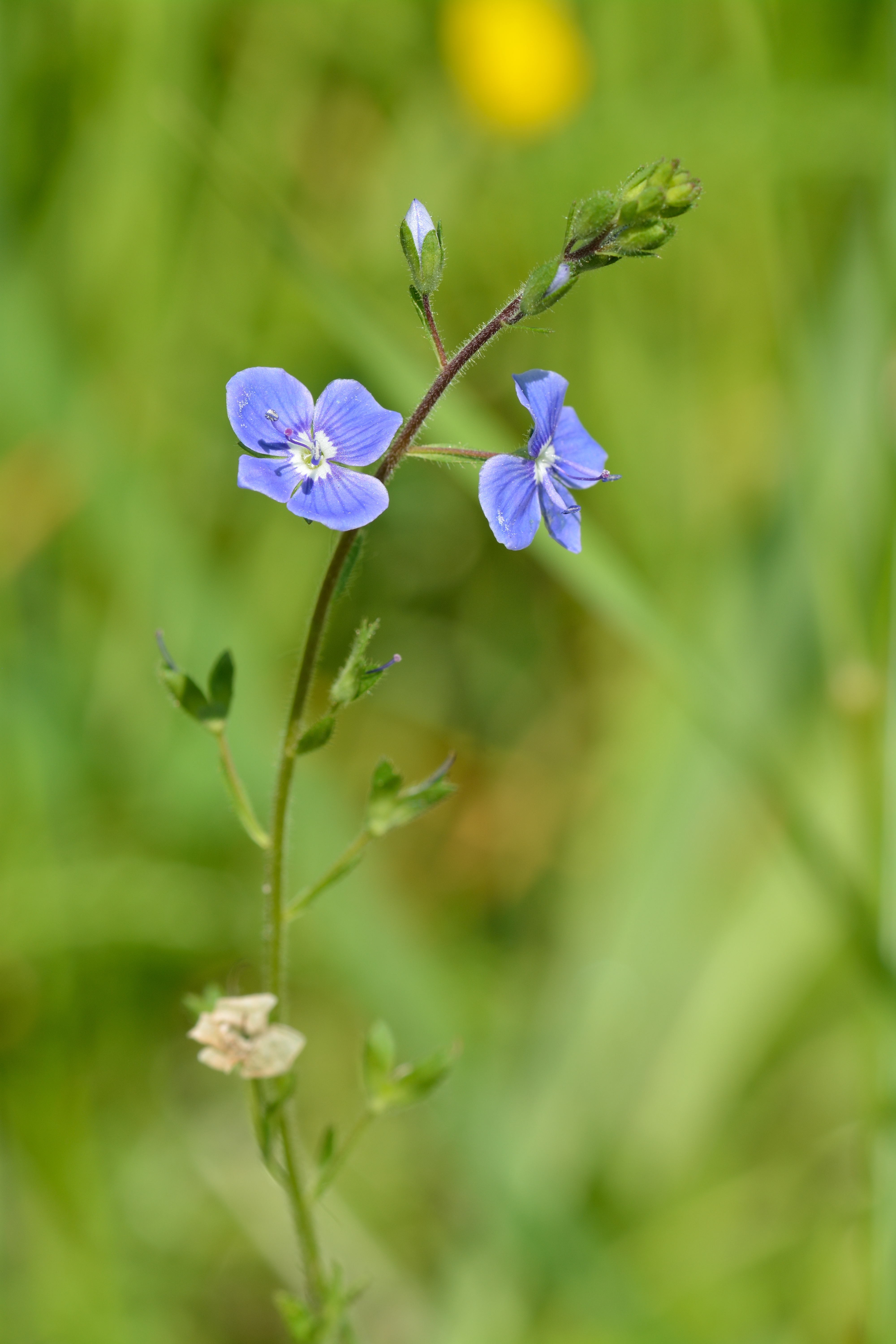
Veronica, commonly known as speedwells, is the largest genus in the flowering plant family Plantaginaceae, encompassing approximately 500 species. The genus includes a diverse range of growth forms — herbaceous annuals, perennials, subshrubs, shrubs, and small trees — united by characteristically rounded stems and small flowers borne on upright, slender racemes that bloom progressively from the base upward. Flowers are typically less than one inch across and appear in shades of blue, pink, purple, lavender, or white, carried on narrow lance-shaped, serrated leaves.
Most species are native to temperate regions of the Northern Hemisphere, particularly Europe and Asia, though the genus also has a substantial Southern Hemisphere presence — especially in New Zealand, which harbours around 160 species (native and introduced) formerly classified under the closely related genus Hebe. In the early twenty-first century, molecular phylogenetic studies led to a major revision: previously segregated Southern Hemisphere genera, including Hebe, Derwentia, Parahebe, Chionohebe, Heliohebe, Leonohebe, and Detzneria, were absorbed into Veronica to achieve a monophyletic circumscription. As of October 2022, approximately 460 accepted species and hybrids are recognised by Kew.
Originally placed in the family Scrophulariaceae, Veronica was transferred to Plantaginaceae following broad molecular work across the order Lamiales. The genus was formally described by Carl Linnaeus in his 1753 Species Plantarum, and the vernacular name speedwell had been in English use since at least 1572. In horticulture, speedwells are valued as low-maintenance perennials that provide strong vertical accents in borders and pollinator gardens, performing reliably across USDA hardiness zones 3a–9b.
Etymology
The genus name Veronica was formalised by Carl Linnaeus in 1753, drawing on a vernacular designation already well established in European usage — English records of the name date to at least 1572. The derivation most commonly proposed is a reference to Saint Veronica, whose name itself traces back to the Greek Berenice. The vernacular English name "speedwell" has been in continuous use alongside the Latin genus name and refers to various species of the group.
Distribution
Veronica has its centre of diversity in the temperate Northern Hemisphere, especially Europe and Asia, with records extending across North America (native and introduced) and into southern South America. Distribution data from the World Checklist of Vascular Plants documents native occurrences from Afghanistan and Algeria in the south to the Aleutian Islands and Altay region in the north, spanning US states including Alaska and Canadian provinces including Alberta. Introduced populations are established on isolated islands such as Amsterdam-St.Paul and Ascension. In Central Europe, over 50 species are documented in Switzerland alone, ranging from lowland meadow plants to alpine specialists such as Veronica alpina. The Southern Hemisphere complement is largest in New Zealand, where approximately 160 species (native and introduced) occur — many formerly classified as Hebe — in habitats spanning from coastal and aquatic environments to alpine zones.
Taxonomy
Veronica was originally placed in Scrophulariaceae, the traditional home of many tubular-flowered herbs. Broad molecular phylogenetic studies conducted in the early twenty-first century revealed that this family was polyphyletic, and Veronica — along with many allied genera — was transferred to Plantaginaceae within the order Lamiales. More significantly, the same studies showed that the former Hebe-alliance genera from the Southern Hemisphere (Hebe, Derwentia, Detzneria, Chionohebe, Heliohebe, Leonohebe, and Parahebe) were nested within Veronica, rendering a narrower circumscription paraphyletic. These genera were accordingly synonymised. As of October 2022 approximately 460 accepted species and hybrids are recognised; GBIF records 985 descendant taxa (including synonyms and infraspecific names). The genus was validly published by Linnaeus in Species Plantarum, page 9 (1753), and is accepted within family Plantaginaceae, order Lamiales, class Magnoliopsida. Swiss records follow Flora Helvetica nomenclature, where the family is indexed as Checklist ID 1049089.
Ecology
Annual life forms have evolved independently multiple times within Veronica, occurring in up to 10% of species. This convergent evolution is interpreted as an adaptation to arid or climatically unpredictable environments, with the Balkan Peninsula proposed as a likely origin point due to its volatile Pleistocene climate history. Larvae of several Lepidoptera, including the grizzled skipper, use Veronica as food plants. In New Zealand the ecological range of the genus is particularly broad, from fully aquatic water speedwells to plants of coastal rocks, montane grasslands, and high alpine fell-fields. Across temperate gardens worldwide, speedwells attract bees, butterflies, and hummingbirds, and some species have become persistent lawn and arable weeds (Persian speedwell, corn speedwell, germander speedwell, ivy-leaved speedwell).
Cultivation
Speedwells are popular low-maintenance perennials cultivated across USDA hardiness zones 3a–9b. They perform best in full sun (6+ hours daily) but tolerate partial shade, and are adaptable to a wide range of soil textures — clay, loam, and sandy soils — and pH levels from acidic to alkaline. Consistent moisture in well-drained soils is preferred; waterlogged or severely dry conditions are unfavourable. Plants provide a strong vertical accent via their characteristic upright flower spikes and are suitable for borders, rock gardens, containers, slopes, and dedicated pollinator gardens. Most species are deer-resistant and rebloom if cut back after the first flowering flush. Several prostrate species serve as ground cover plants, and cut flower use is also documented.
Propagation
Veronica can be propagated by division, seed, or stem cuttings. Seed is best sown in a greenhouse in spring with minimal covering. Semi-ripe (half-ripe) wood cuttings of 3–5 cm taken in July or August root well, and mature wood cuttings can also be taken in late autumn or winter. Cultivars and selected varieties must be propagated asexually — by division or cuttings — to reliably maintain their characteristics, as seedlings of named cultivars will not breed true.
Conservation
Within New Zealand, where Veronica encompasses former Hebe taxa, several species face significant conservation pressure. Veronica adamsii, Veronica armstrongii (Armstrong's whipcord), and Veronica barkeri (Barker's koromiko) are assessed as Threatened – Nationally Critical under the New Zealand Threat Classification System. Many additional NZ species are listed as At Risk – Naturally Uncommon. Swiss populations are assessed through national red-list evaluations maintained by Info Flora, with conservation status assigned at the individual species level.
Cultural Uses
Several Veronica species have documented food and medicinal uses. Veronica americana (American brooklime) is edible and reportedly tastes similar to watercress. Native American peoples used Veronica preparations as an expectorant tea for bronchial congestion. In Austrian traditional medicine, speedwell herb was used internally for ailments of the nervous, respiratory, cardiovascular, and metabolic systems. Veronica officinalis (heath speedwell) has a long history of use as a herbal tea in Central Europe. Some species, notably V. beccabunga (brooklime), were historically consumed as pot herbs and salad plants.










