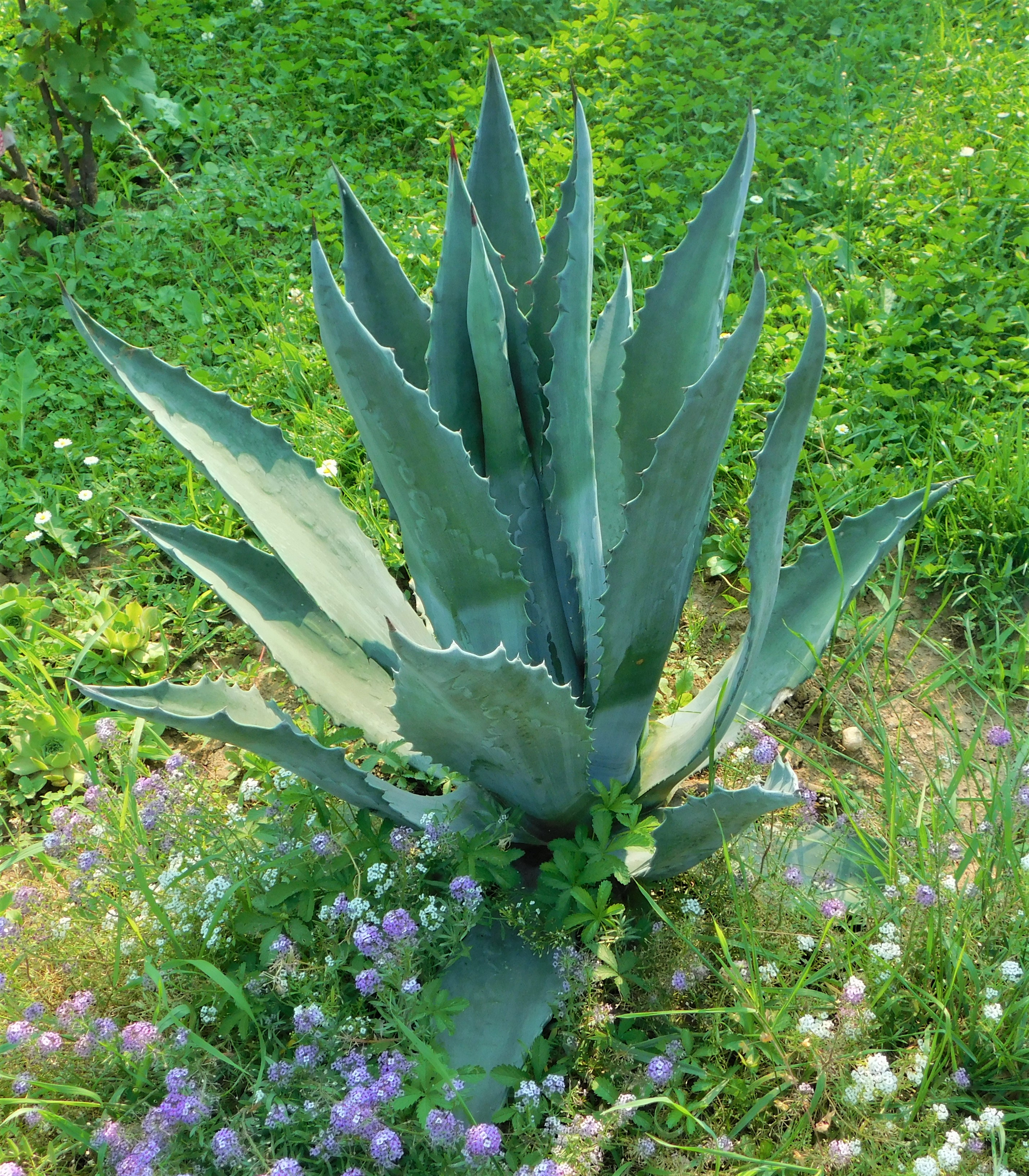
Agave is a genus of approximately 200 succulent perennial species in the family Asparagaceae (subfamily Agavoideae), native to the arid and semi-arid regions of the Americas — principally Mexico, the southwestern United States, the Caribbean, and Central America. The genus was described by Carl Linnaeus in 1753, with Agave americana as the type species.
Plants grow as dramatic rosettes of thick, fleshy, evergreen leaves with sharp marginal teeth and a rigid terminal spine. Rosettes range enormously in size, from compact specimens of a few inches to giants reaching 3 metres across and 3 metres tall. Leaves are linear-lanceolate to ovate in outline; margins may be entire, filiferous (thread-bearing), or armed with teeth. Flowers are mostly yellow, protandrous, and carried in tall spicate, racemose, or paniculate inflorescences on flowering stalks ("masts") that can soar to 12 metres (40 feet) in height. Fruits are capsular, oblong to ovoid, with black, flattened seeds.
Most agave species are monocarpic: each rosette flowers only once — typically after 5 to 60 years of vegetative growth — and then dies. The plant compensates for this terminal reproduction by producing rhizomatous offsets ("pups") that form daughter rosettes around the base, ensuring the colony persists. Some species are polycarpic and produce multiple flowering events. The genus name derives from the Ancient Greek agauós (ἀγαυός), meaning "illustrious" or "noble," in reference to the impressively tall flowering structures.
Agave has been naturalized throughout the Mediterranean, South Africa, and parts of Asia since its introduction to Europe in the mid-16th century. GBIF records 536 descendant taxa across the genus. The taxonomy is complicated by ease of hybridization and centuries of cultivation; numerous former genera — including Manfreda, Polianthes, and Bravoa — have been subsumed into Agave by molecular studies.
Etymology
The genus name Agave was coined by Carl Linnaeus in 1753 and comes from the Ancient Greek adjective agauós (ἀγαυός), meaning "illustrious," "noble," or "admirable." The epithet is widely understood to refer to the spectacularly tall flowering stalks that tower over the otherwise low-growing rosette. In East Asian languages the plants acquired the folk name "dragon tongue orchid" (Chinese: 龙舌兰; Japanese: 竜舌蘭; Korean: 용설란), reflecting the long, tongue-like leaves rather than any botanical relationship to orchids.
Distribution
Agave is native to the arid and semi-arid Americas, with its greatest diversity centered in Mexico and the southwestern United States. The genus extends into the Caribbean and Central America, with a secondary center of diversity in the Chihuahuan and Sonoran deserts. Documented species in the southwestern United States include A. chrysantha, A. deserti, A. murpheyi, A. palmeri, A. parryi, A. parviflora, and A. utahensis; at least one undescribed species occurs in the Grand Canyon region.
Following European contact, agaves were introduced to the Mediterranean basin, the Canary Islands, South Africa, and parts of Asia. By the mid-16th century they were established in southern Europe, and they have since naturalized widely across warm-temperate and subtropical regions worldwide.
Ecology
Agave species are adapted to arid and semi-arid terrestrial habitats and are characterized by Crassulacean Acid Metabolism (CAM) photosynthesis, which reduces water loss. The dominant life strategy is monocarpy: a rosette devotes years or decades to vegetative growth — commonly 8–20 years, occasionally up to 60 — accumulating sugars in the stem before producing a single massive inflorescence and dying. Vegetative reproduction through basal offsets and, during flowering, bulbils (aerial plantlets) on the inflorescence compensates for this terminal reproduction.
The large, nectar-rich flowers attract a broad suite of pollinators. Bees, butterflies, hummingbirds, bats, and other mammals are all documented visitors, making agaves important ecological resources in desert communities. The leaves are a food source for larvae of some Lepidoptera, including Batrachedra striolata. Chromosome number is x = 30 (5 large and 25 small), and the genus hybridizes readily; several named interspecific hybrids — including Agave ×ajoensis and A. ×arizonica — are believed to have originated through pre-Columbian agricultural cultivation.
Cultivation
Agaves are prized ornamental plants for warm, dry climates. They thrive in full sun (at least 6 hours daily), require sharply drained sandy or loamy soils, and are exceptionally drought-tolerant once established — needing very little supplemental water to survive. Most cultivated species suit USDA hardiness zones 9a–11b, though A. americana is hardy to approximately −9.5 to −6.5°C (Zone 8b) when kept dry. Some species tolerate around −3°C in dry conditions.
Plant sizes range widely by species: spacing from 12 inches to over 12 feet should be planned at installation, as agaves resent transplanting once established. Their slow growth makes them low-maintenance; many cultivated specimens take 5–60 years to flower. Agaves are well suited to xeriscaping, rock gardens, containers, and as bold specimen or accent plants. Contact with fresh sap can cause contact dermatitis in sensitive individuals, and the terminal spine and leaf teeth warrant careful siting away from paths.
Common pests include the agave snout weevil (Scyphophorus acupunctatus), mealybugs, scale insects, and mites. Overwatering is the most frequent cultural mistake and promotes root rot.
Propagation
Agaves are propagated by several methods. The most straightforward is division of offsets ("pups") that naturally form around the base of established rosettes; these are separated and rooted in warm conditions. During the flowering event, many species produce bulbils — aerial plantlets along the inflorescence — that can be collected, potted, and grown on.
Seed propagation is also possible: seeds are surface-sown in spring and germinate in 1–3 months at 20°C (68°F). Because agaves are monocarpic and most species take many years to flower, seed batches are infrequent under garden conditions. Rhizome division is an additional vegetative option for multi-stemmed clumps.
Cultural Uses
Agave has sustained human civilizations in the Americas for thousands of years. William H. Prescott recorded in 1843 that the agave provided the Aztecs with "meat, drink, clothing, and writing materials" — an encompassing statement borne out by archaeology and ethnobotany.
Four principal edible parts are recognized: flowers, leaves, stalks and basal rosettes (the "heart" or piña), and the sweet sap (aguamiel, meaning "honey water"). The piña, rich in fermentable saccharides, is the raw material for pulque (fermented sap), mezcal, and tequila. Agave tequilana ('Weber's Blue') is the sole legally permitted source for tequila under a 2001 Mexican-EU agreement; A. angustifolia and other species are widely used for mezcal. Flower stalks can be roasted and eaten like asparagus; seeds are ground into flour; the sap can be reduced to a sweet syrup or fermented. The plant takes roughly 7–10 years to reach harvest maturity under cultivation.
Fiber extraction has been equally important. Agave sisalana yields sisal, one of the world's principal natural hard fibers, used in rope and twine; A. americana provides pita fiber. The Hohokam of the southwestern United States cultivated large agave fields, and the Navajo used multiple plant parts for food, fiber, basketry, and baking.
Medicinally, the sap has been documented as having antiseptic, diaphoretic, diuretic, and laxative properties. Traditional preparations address diarrhea, dysentery, indigestion, and constipation. Steroidal drug precursors have been extracted from agave leaves in the modern pharmaceutical context.
Taxonomy Notes
Agave L. was published in Linnaeus's Species Plantarum (1753, p. 323) with Agave americana as the type species. It belongs to the family Asparagaceae, order Asparagales, class Liliopsida, and is placed in the subfamily Agavoideae. GBIF recognizes 536 descendant taxa under the genus key 2766430. Chromosomal base number is x = 30.
Modern molecular phylogenetics has dramatically expanded the traditional boundaries of Agave. Numerous formerly separate genera are now treated as synonyms, including Manfreda Salisb. (which includes tuberose), Polianthes L., Bravoa Lex., Littaea Tagl., Prochnyanthes S.Watson, Runyonia Rose, Coetocapnia Link & Otto, Delpinoa H.Ross, and others. The genus hybridizes readily, producing fertile interspecific hybrids, which has historically complicated taxonomy. Several named hybrids — such as Agave ×ajoensis and A. ×arizonica — likely originated through pre-Columbian agricultural selection.










