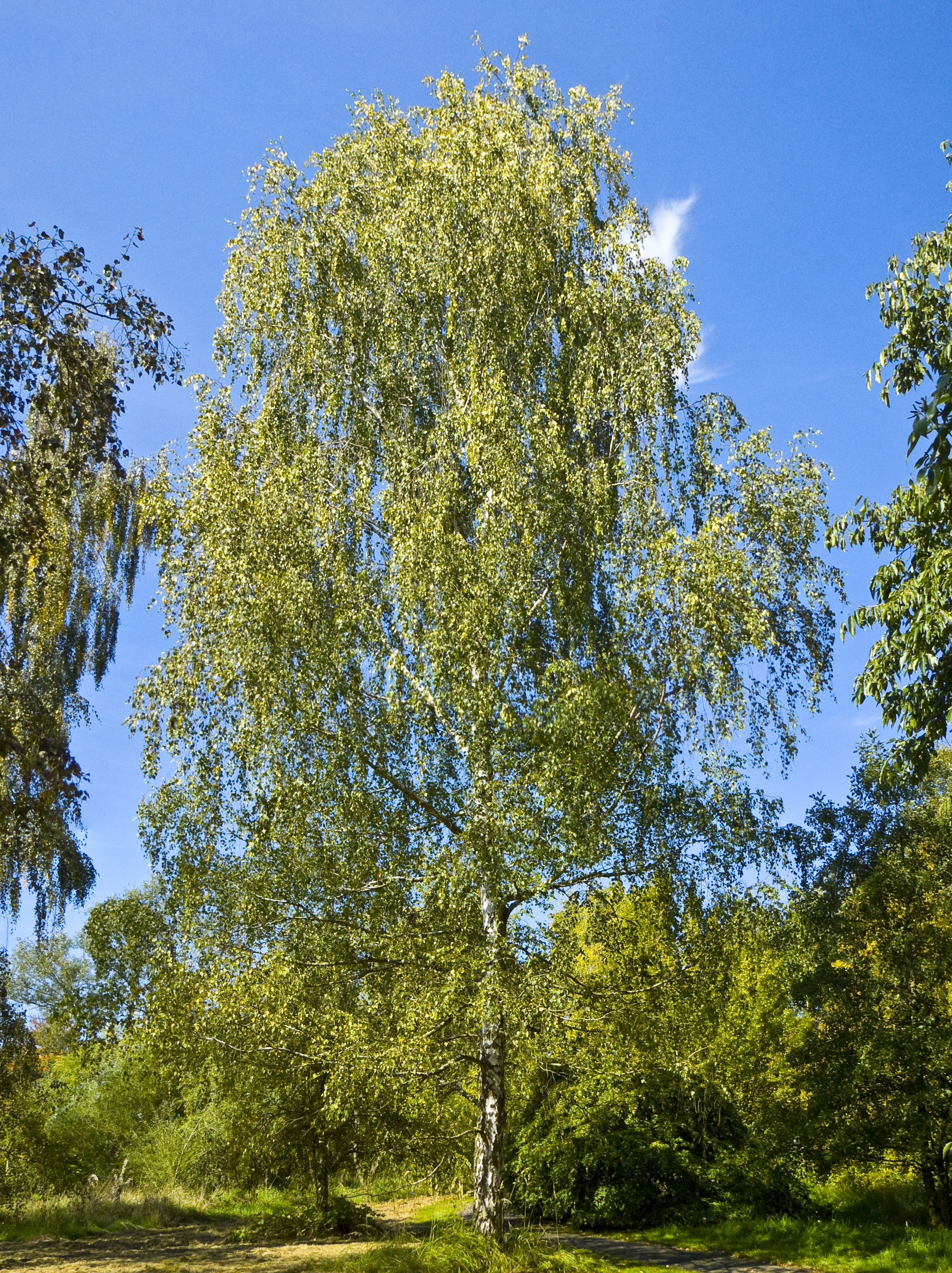
Birches (genus Betula) are small to medium-sized deciduous trees and shrubs in the family Betulaceae, order Fagales. The genus was established by Linnaeus and today encompasses roughly 30 to 60 species — Encyclopedia Britannica gives a working figure of about 40 — distributed almost entirely across the cool, temperate, and boreal regions of the Northern Hemisphere. Their natural range stretches from Europe through Russia to China, Japan, and the Himalayas, with several species native to North America.
The defining feature of most birches is their bark: smooth, resinous, and conspicuously marked with horizontal lenticels, often peeling away in thin, papery sheets. Bark colour ranges from the brilliant chalk-white of Betula utilis var. jacquemontii and B. papyrifera through the silvery grey of B. pendula to the cinnamon and salmon hues of B. nigra. Leaves are alternate, simple, egg-shaped or triangular, doubly serrate, and appear in pairs on spur-like short shoots; they typically turn clear yellow in autumn. Birches are monoecious, producing slender pendulous male catkins that open before the leaves and smaller, upright female catkins on the same tree. The female catkins mature into cone-like clusters that disintegrate to release tiny one-seeded winged nutlets.
Ecologically, birches are classic pioneer species, quick to colonise ground exposed by fire, windthrow, or human clearing. They favour light, well-drained, acidic soils and tend to be short-lived, forming even-aged stands that are eventually overtopped by longer-lived hardwoods. The foliage supports a remarkable diversity of lepidopteran larvae, making birch stands valuable wildlife habitat. The genus belongs in family Betulaceae alongside its close relative Alnus (alder), and is taxonomically subdivided into five subgenera — Betulenta, Betulaster, Neurobetula, Betula, and Chamaebetula. Hybridisation between sympatric species is frequent. The oldest known fossil, Betula leopoldae, dates to the early Eocene around 49 million years ago.
Few trees carry as heavy a cultural and economic load as the birches. Their pale, fine-grained wood is used for plywood, furniture, cabinetry, flooring, drum shells, skateboard decks, and pulp. Sap tapped in spring is fermented into birch beer or boiled down into syrup; the inner bark is an emergency food, and bark from B. lenta historically supplied wintergreen oil. Indigenous peoples across the boreal North used birch bark for canoes, containers, and wigwams, while in India and Russia it served as a writing surface for centuries. The silver birch is the national tree of Finland and Russia, the paper birch is the state tree of New Hampshire, and the yellow birch is the official tree of Québec.
Etymology
The genus name Betula is the classical Latin word for the birch tree, a diminutive borrowed from the Gaulish betua. The English common name "birch" traces a separate but parallel etymology: from Old English birce, via Proto-Germanic berk-jōn, back to a Proto-Indo-European root bʰerHǵ- meaning "to shine" or "to whiten" — a clear reference to the brilliant white bark of many species.
Distribution
Birches are essentially a Northern Hemisphere genus, distributed across the cool temperate and boreal zones from western Europe through Russia, China, Japan, and the Himalayas, and across most of forested North America. In Switzerland, for example, four native species occur — B. humilis, B. nana, B. pendula, and B. pubescens — spanning everything from dwarf alpine shrubs to full-sized lowland trees. Several species, notably B. pendula, have naturalised well beyond their native ranges, including New Zealand and parts of North America.
Ecology
Birches are textbook pioneer species, exploiting open ground after wildfire, windthrow, or clearcut and forming dense, even-aged cohorts of relatively short-lived individuals. They favour light, well-drained, acidic soils and full sun, and are generally outcompeted in the long run by shade-tolerant climax species. Their foliage hosts an unusually large guild of lepidopteran herbivores, and their abundant catkins and seed make them important resources for boreal and temperate wildlife.
Cultivation
White-barked birches have been planted as garden trees in Europe since at least the 1870s. They are valued for the bark itself, fine-textured foliage that turns yellow in autumn, and graceful airy crowns. Cultivation succeeds best on well-drained, acidic soils in full sun; established cultivars such as 'Doorenbos', 'Grayswood Ghost', 'Silver Shadow', and 'Knightshayes' (all B. utilis forms) are grown for especially clean white bark. Birches are typically short-lived under garden conditions and respond poorly to compacted or waterlogged soils.
Propagation
Birches are most often raised from seed, which is produced in large quantities by mature catkins and germinates readily after stratification on a moist, exposed surface.
Conservation
The bulk of the genus remains widespread and common in its native range, but eleven Betula taxa were listed on the IUCN 2011 Red List of Threatened Species — largely rare regional endemics in Asia.
Cultural Uses
Few tree genera carry as broad a cultural footprint as Betula. The pale, fine-grained timber is used for plywood, furniture, cabinetry, flooring, interior finishing, vehicle parts, drum shells, skateboard decks, model aircraft, popsicle sticks, pulp, and turnery. Spring-tapped sap yields birch syrup and is fermented into birch beer; the inner bark serves as emergency food, and bark from B. lenta was once distilled for wintergreen oil. A standardised birch-bark extract was authorised in the European Union in 2016 as a topical treatment for minor skin wounds. Indigenous peoples across the North American boreal forest used birch bark for canoes, bowls, and wigwams; in India (bhurja patra) and Russia (beresta) it served as a writing surface for centuries. The silver birch is the national tree of Finland and Russia; the paper birch is the state tree of New Hampshire; and the yellow birch is the official tree of Québec.
Taxonomy Notes
Betula L. is the type genus of family Betulaceae (order Fagales), accepted in the GBIF Backbone Taxonomy with ~294 descendant taxa and divided into five subgenera — Betulenta, Betulaster, Neurobetula, Betula, and Chamaebetula. Wikipedia treats the genus as containing 30–60 species, while Encyclopedia Britannica gives a working figure of about 40; the discrepancy reflects ongoing disagreement over the rank of microspecies and frequent hybridisation between sympatric taxa (for example B. pendula × B. pubescens in the British Isles). The genus has a deep fossil record, with Betula leopoldae dated to the early Eocene around 49 million years ago.










