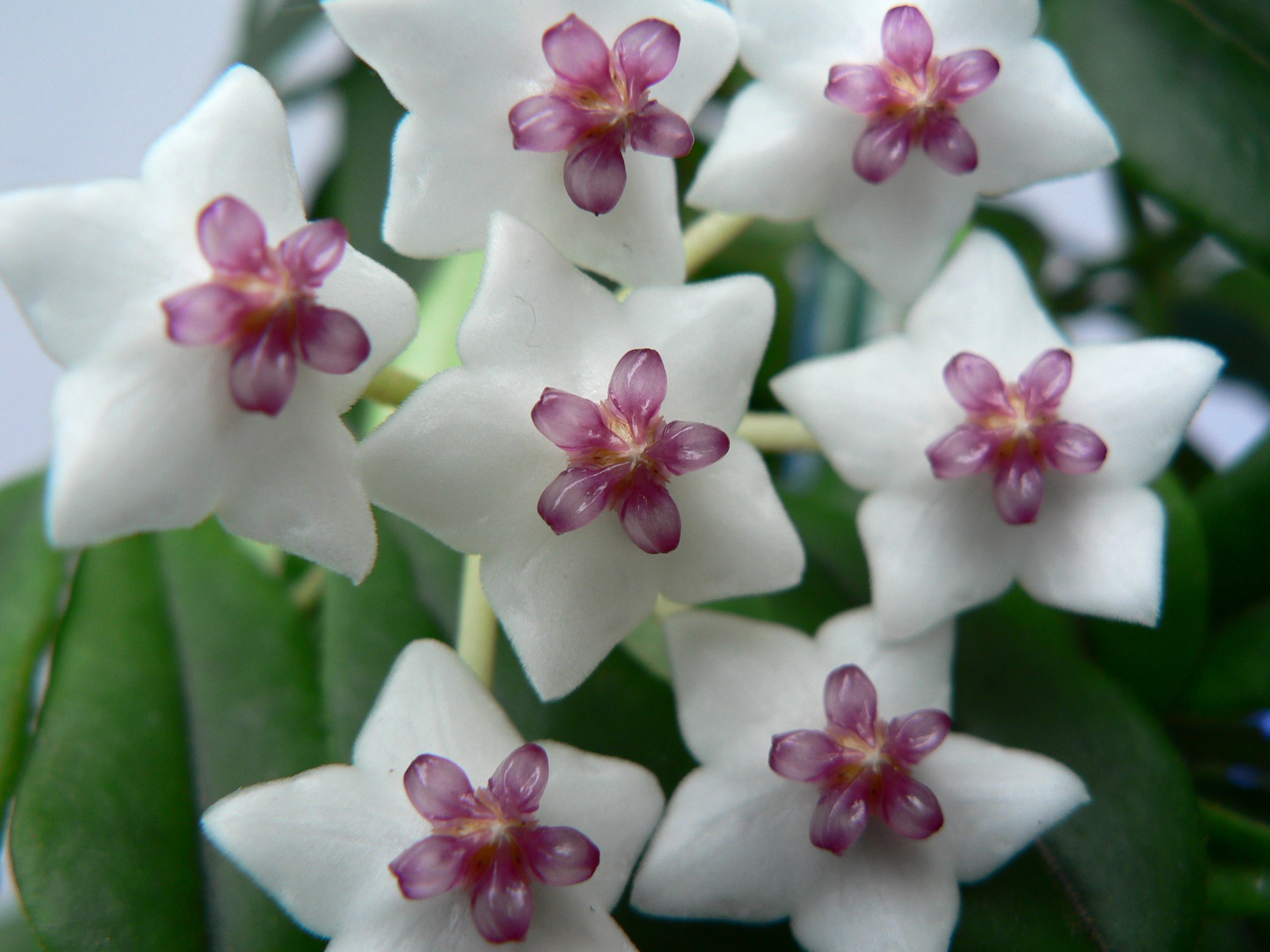
Hoya is a large genus of over 500 accepted species of climbing, epiphytic, and lithophytic perennial plants in the family Apocynaceae (the dogbane family), commonly known as wax plants or waxflowers. The genus was formally described by the Scottish botanist Robert Brown in his 1810 work Prodromus Florae Novae Hollandiae et Insulae van Diemen and named in honour of Thomas Hoy, a gardener in the service of the Duke of Northumberland.
Plants in the genus are predominantly vines with leathery, often fleshy or succulent leaves that vary from elliptic to lance-shaped. Their most distinctive feature is the flower: small, star-shaped, and arranged in rounded umbels or racemes, each bloom waxy or fleshy in texture, frequently fragrant, and appearing in shades of white, pink, red, cream, or variegated combinations. Fruits are spindle-shaped to oval follicles containing flattened, plumed seeds adapted for wind dispersal.
The genus is native to tropical and subtropical regions of Asia and the western Pacific, ranging across India, Bangladesh, southern China, Southeast Asia, Malaysia, Indonesia, the Philippines, and Pacific island groups including Fiji, Samoa, and the Solomon Islands. Introduced populations have been recorded in parts of the Caribbean. In their native habitats, Hoyas grow as epiphytes on trees or as lithophytes on rocks, often in humid forest understories.
Many species have been cultivated as houseplants worldwide, prized for their ornamental foliage, long-lived flowers, and relatively undemanding care requirements. Hoya carnosa, the wax plant, is the most widely grown species and serves as the type species of the genus. Plants are frost-sensitive and are grown indoors or under glass in temperate climates, where they benefit from bright, indirect light and a free-draining potting medium allowed to dry between waterings.
Etymology
The genus name Hoya was coined by Robert Brown and published in 1810. Brown dedicated it to Thomas Hoy (c. 1750–1821), the head gardener at Syon House, Middlesex — the estate of the Duke of Northumberland — who cultivated many tropical plants and contributed specimens to botanical study. The name carries no descriptive meaning in Latin or Greek; it is a pure patronym.
Distribution
Hoya is native to a broad arc of tropical and subtropical Asia and the western Pacific. Its core range extends from the Andaman Islands, India, and Bangladesh eastward through Myanmar, Thailand, Cambodia, Vietnam, southern China (including Yunnan and Guangdong), and Japan, and southward through the Malay Peninsula, Borneo, Sumatra, Java, Sulawesi, and the Philippines. Pacific populations occur in Fiji, Samoa, Vanuatu, and the Solomon Islands. Introduced naturalised populations have been reported in Cuba, Puerto Rico, and other Caribbean islands.
Within this range, most species occupy humid tropical and subtropical forest, growing as epiphytes on the trunks and branches of trees or occasionally as lithophytes on rocky outcrops. The genus reaches its greatest diversity in Southeast Asia and the island of Borneo in particular.
Taxonomy
Hoya R.Br. is an accepted genus in the family Apocynaceae (order Gentianales), placed within the former subfamily Asclepiadoideae. The Plants of the World Online (POWO) recognises 569 accepted species; GBIF lists 768 descendant taxa when infraspecific ranks are included. The type species is Hoya carnosa (L.f.) R.Br.
The genus has accumulated 24 heterotypic synonyms, reflecting historical attempts to segregate morphologically distinct groups into separate genera. These include Acanthostemma, Astrostemma, Centrostemma, Schollia, and Sperlingia, all now absorbed into Hoya. GBIF records authorship as R.Br. 1809, citing Mem. Wern. Soc. 1: 26, while POWO cites the Prodromus of 1810 as the primary publication — both refer to the same sustained act of publication.
Ecology
Hoyas are principally epiphytic or lithophytic, growing without soil on host trees or rocks in humid forest understories. As epiphytes, they obtain moisture from rainfall, mist, and organic debris that collects around their roots rather than from the ground. Their leathery, often fleshy leaves serve as water-storage organs, allowing the plants to tolerate periodic drought between rains.
Flowers are typically pollinated by insects, attracted by the nectar secreted from the corona and often by strong fragrance. Seeds bear a tuft of silky hairs (comose) that facilitates wind dispersal across the canopy. In cultivation, common invertebrate pests include aphids, spider mites, and mealybugs; root rot is the principal physiological problem, arising from excessive soil moisture. Some species are noted as toxic to livestock.
Cultivation
Hoyas are among the most popular tropical houseplants in temperate regions, valued for their ease of care, ornamental foliage, and long-lasting, often fragrant flowers. They require a free-draining, organic potting medium — such as a bark and perlite mix — that is allowed to dry partially between waterings, as roots are highly susceptible to rot in persistently wet conditions. Most species perform best in bright, indirect light or dappled shade; full morning sun is generally tolerated, but harsh afternoon sun can scorch leaves.
All species are frost-tender and must be overwintered indoors or under glass in temperate climates. Plants grow at a moderate pace and, as natural climbers or trailers, benefit from a trellis or pole for support; trailing species perform well in hanging baskets. Many species produce flowers only on mature spurs (peduncles) that persist year after year — these should not be removed after flowering, as new flower clusters will emerge from the same structures in subsequent seasons.
Propagation
The most common propagation method is stem cuttings. A cutting of two to four nodes is taken, the lower leaves removed, and the cut end allowed to callous briefly before being inserted into a free-draining propagation mix (e.g., perlite or coarse bark). Bottom heat and high humidity accelerate rooting. Cuttings typically root within four to eight weeks under warm conditions. Layering (allowing a stem to root while still attached to the parent plant) is also practised for species that are slow to root from cuttings.
Cultural Uses
Several Hoya species have documented ethnobotanical uses across their native range. Various cultures have employed hoyas medicinally, and this harvesting pressure has been noted as a factor contributing to population decline in some localities. Hoya carnosa has been studied for its capacity to remove volatile organic compounds from indoor air, supporting its use as an air-purifying houseplant. Some species are reported to be toxic to livestock, which influences their management in agricultural settings.










