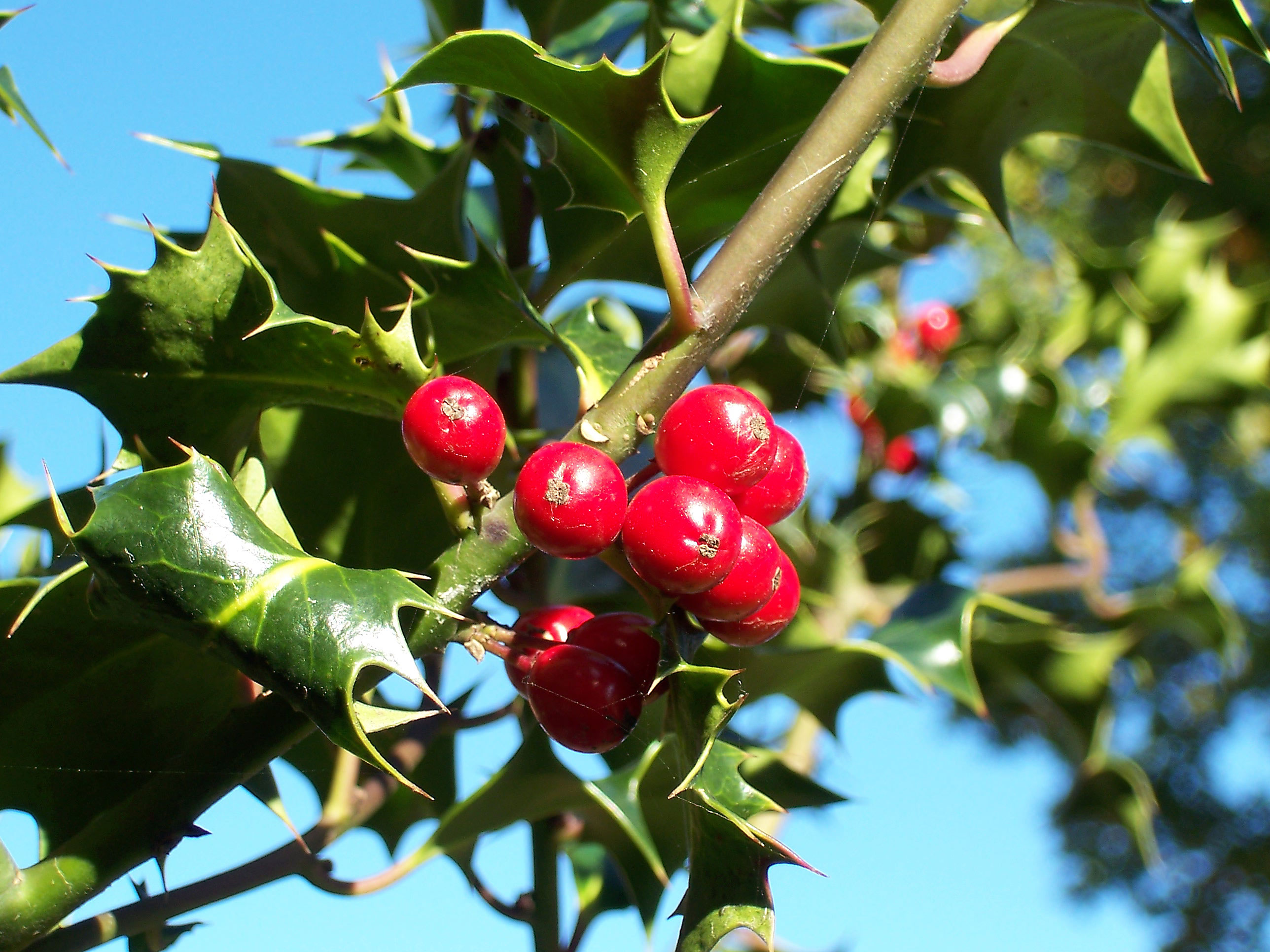
Ilex, commonly known as holly, is the sole living genus in the family Aquifoliaceae, encompassing approximately 570 species of evergreen and deciduous shrubs and trees. It holds the distinction of being the most species-rich genus of woody dioecious angiosperms on Earth. Plants range from low-growing shrubs to trees reaching 25 meters in height, and are united by their simple, alternate leaves — frequently toothed or spiny — small greenish-white four-petaled flowers, and characteristic berry-like fruits that are technically drupes.
Hollies are strictly dioecious: male and female flowers are borne on separate plants, which means that both a male and at least one female must be present nearby for fruit production. The drupes are typically red, though yellow, orange, black, and green forms exist, and each drupe contains up to ten seeds. Flowering occurs in spring; fruits ripen in autumn and often persist through winter, providing an important food source for birds and other wildlife during cold months.
The genus is distributed across temperate and tropical forests on every continent except Antarctica, with the greatest species diversity concentrated in the Americas and Southeast Asia. China alone harbors 204 species, of which 149 are endemic. In Europe, Ilex aquifolium (European holly) is the dominant representative. The genus is equally at home in lowland forests, montane habitats, and forest margins.
Hollies are cultivated worldwide for ornamental purposes — as specimen trees, hedges, and topiary — valued for their glossy foliage, attractive berries, and year-round structure. They generally prefer acidic, well-drained soils in full sun to partial shade, though most species show considerable tolerance for drought, shade, and air pollution. Several species have significant economic and cultural importance beyond horticulture: Ilex paraguariensis is the source of yerba mate, and Ilex vomitoria was historically brewed into a caffeinated ceremonial drink by Indigenous peoples of the southeastern United States.
Etymology
The genus name Ilex is the classical Latin word for the holm oak (Quercus ilex), an evergreen Mediterranean oak whose tough, leathery leaves were considered analogous to those of holly. The common name "holly" descends from the Old English "hole(ġ)n," which passed through Middle English forms including "Holin" and "Hollen" before arriving at the modern spelling. In Romance languages, holly is often referred to using the epithet "acrifolium," from the Latin for "sharp leaf" — a direct reference to the genus's characteristic spiny leaf margins.
Distribution
Ilex has a nearly worldwide distribution, occurring in temperate and tropical forests on every continent except Antarctica. The greatest concentrations of species diversity are found in the Americas and Southeast Asia. China is the single most species-rich country for the genus, with 204 species recognized, of which 149 are endemic to China. In Europe, Ilex aquifolium is the principal wild representative. In the Americas, hollies are distributed broadly throughout eastern North America — with as many as 14 species native to North Carolina alone — as well as into Central and South America. Australia contributes Ilex arnhemensis, while other species occur across tropical Africa and island Southeast Asia.
Taxonomy
Ilex L. (authority: Linnaeus) is the only extant genus in the family Aquifoliaceae. With approximately 570 species, it is the most species-rich genus of woody dioecious angiosperms known. The type species is Ilex aquifolium. The genus was formally described by Philip Miller in his Gardeners Dictionary (4th abridged edition, 1754), and is recognized with accepted status under the GBIF backbone taxonomy. The family Aquifoliaceae belongs to the order Aquifoliales within the eudicot clade.
Ecology
Holly fruits are a key winter food resource for birds and small mammals, remaining on branches long after leaf drop in deciduous species. The small, fragrant flowers attract bees and other pollinators in spring. Various Lepidoptera larvae are known to feed on holly foliage. In terms of invasive ecology, Ilex aquifolium (English holly) has spread aggressively into native forest habitats along the Pacific coast of North America, where it outcompetes native understory plants and is classified as an invasive species in that region.
Cultivation
Hollies are widely cultivated as ornamental plants, used for specimen planting, hedging, screening, and topiary. They perform best in full sun to partial shade in acidic, well-drained soils, though they tolerate a broad range of soil types including poor and compacted ground. Established plants are notably tolerant of drought, shade, and urban air pollution. Hollies transplant readily. Because the genus is dioecious, both male and female plants must be grown in proximity to ensure fruit production — a key consideration when planting for ornamental berry display. Most deciduous species are less suited to high-heat, high-humidity climates (USDA zones 8–9).
Propagation
Ilex can be propagated by seed or by stem cuttings. Seed propagation requires patience, as holly seeds exhibit deep dormancy and may take two or more years to germinate without stratification treatment. Vegetative propagation via semi-hardwood cuttings is the more common horticultural method, allowing cultivar characteristics to be reliably maintained.
Conservation
At least two species of Ilex have become extinct in recent times. Across the tropics, many Ilex species face mounting threats from habitat destruction and overexploitation, with numerous taxa now classified as rare or at risk. The genus's high rate of endemism — particularly in China and the Neotropics — means that localized deforestation can eliminate entire species with restricted ranges.
Cultural uses
Holly has deep cultural resonance across multiple traditions. In Western Christianity, Ilex aquifolium is closely associated with Christmas symbolism: its spiny leaves represent the crown of thorns placed on Jesus, while the red berries symbolize drops of Christ's blood. In heraldry, holly is a symbol of truth and constancy.
Several Ilex species are economically significant as sources of caffeinated beverages. Ilex paraguariensis is the source of yerba mate, among the most widely consumed beverages in South America. Ilex guayusa (guayusa) is consumed in the Amazon basin. Ilex vomitoria (yaupon) was historically brewed as a ritual caffeinated drink by Indigenous peoples of the southeastern United States, and interest in its commercial cultivation has revived in recent years. Kuding, a bitter tea made from certain Ilex species, is consumed in East Asia.
In traditional Chinese medicine, Ilex root is an ingredient in Gan Mao Ling, a preparation used for the early treatment of colds and flu. Holly berries in some traditions are also fermented to produce a distilled spirit (eau de vie).
History
The Ilex lineage has ancient origins, predating the end of the Cretaceous period. The earliest known pollen attributable to Ilex comes from Turonian-age deposits in Australia, placing the genus at well over 90 million years old. Molecular clock analyses suggest that the common ancestor of all living Ilex species diverged during the Eocene epoch, approximately 50 million years ago, coinciding with a period of global warmth that favored the diversification of many angiosperm lineages.










