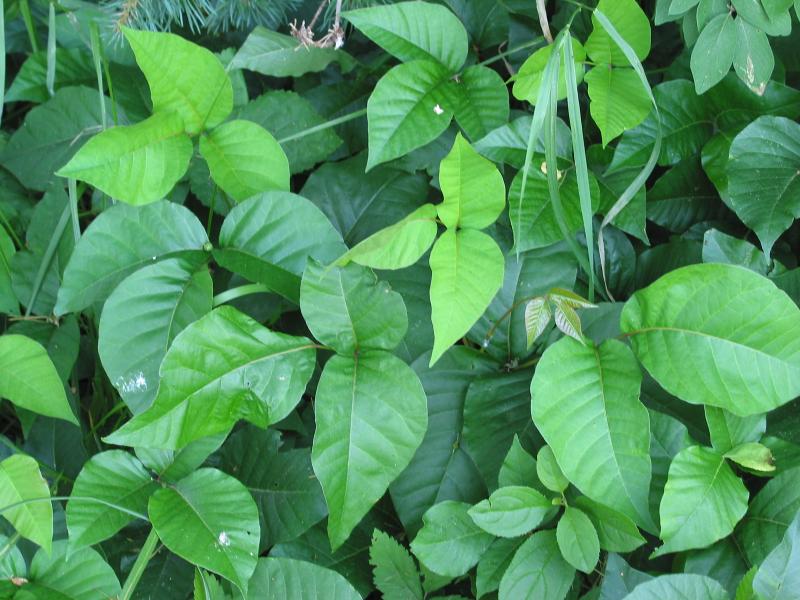
Toxicodendron is a genus of flowering plants in the cashew family Anacardiaceae, order Sapindales. The name combines the Greek words toxikón ("poison") and déndron ("tree") — a reference to the genus's defining and unwelcome feature: every species produces urushiol, the resinous phenolic oil responsible for one of the world's most widespread cases of allergic contact dermatitis. The genus was formally circumscribed in the mid-18th century and has historically drifted in and out of synonymy with Rhus, the broader sumac genus to which it remains closely allied; modern treatments generally accept it as a distinct lineage, though estimates of its size range from roughly fifteen to twenty-nine accepted species depending on the checklist consulted.
Members of Toxicodendron are remarkably variable in habit. They include creeping ground-cover vines, climbers that ascend tall trees by means of aerial roots up to about thirty metres, low rhizomatous shrubs, and small deciduous trees. The leaves are alternate and pinnately compound — the classic "leaves of three, let it be" pattern of poison ivy is one expression of this — and turn striking shades of red, orange, and gold in autumn. Plants are typically dioecious, with separate male and female individuals bearing inconspicuous greenish to whitish flowers in axillary panicles. The fruits are small, dry, cream-coloured to grayish drupes, finely striate and hairless, persisting on bare stems through winter.
The genus is distributed across temperate and subtropical regions of the New World and eastern Asia, with major centres of diversity in North America and East Asia. North American species include eastern poison ivy (T. radicans), western poison ivy (T. rydbergii), western poison oak (T. diversilobum), Atlantic poison oak (T. pubescens), and poison sumac (T. vernix), the last considered the most virulent of the genus. Asian members include the Japanese lacquer tree (T. vernicifluum) and the wax tree (T. succedaneum), both economically important sources of natural lacquer and vegetable wax. Despite the genus's reputation, its fruits are an important winter food source for many birds and small mammals, which disperse the seeds without ill effect, and its autumn colour and ecological role make it a recognisable, if cautiously regarded, component of temperate woodland flora.
Etymology
The genus name Toxicodendron is formed from the Greek toxikón, meaning "poison" (originally an arrow-poison), and déndron, "tree" — literally the "poison tree." The label has been applied to plants in the Rhus alliance since at least the 18th century, recognising the consistent ability of these species to cause severe contact dermatitis through the oil urushiol present in all parts of the plant.
Distribution
Toxicodendron has a disjunct distribution centred on two regions: the New World — chiefly North America, with a southward extension into South America — and eastern Asia, including China, Japan, and Korea. In North America the genus reaches from southern Canada through the United States and into northern Mexico, with species occupying both the southwestern and northeastern regions of the country. Several Asian species are cultivated and have naturalised well beyond their native range; T. radicans, for example, is documented as the only Toxicodendron species in the wild flora of Switzerland, where it appears as a non-native species being tracked by national flora authorities. The genus as a whole spans temperate to subtropical climates.
Ecology
Toxicodendron species are best known for producing urushiol, a mixture of resinous catechol-derived phenolic compounds present in the leaves, stems, roots, fruit, and even old, dried specimens. Contact with urushiol triggers a delayed type-IV hypersensitivity reaction in most humans, producing the intensely itching, blistering rash of poison-ivy or poison-oak dermatitis; toxicity does not diminish with age, and burning plant material can produce dangerous airborne urushiol. The plants themselves use these compounds defensively but interact more amicably with wildlife: the small cream-coloured drupes are eaten and dispersed by birds without harm, and the foliage supports a number of insect herbivores. Many species form thickets or climb existing trees, contributing to forest understorey structure and successional vegetation in disturbed or edge habitats.
Cultural Uses
Despite their notoriety as skin irritants, several Toxicodendron species have long histories of human use. In East Asia, T. vernicifluum — the lacquer tree — is the source of urushi, the natural lacquer used for millennia in Japanese, Chinese, and Korean decorative arts; sumac wax produced from T. succedaneum and related species is a traditional byproduct of the same craft, used in candles, polishes, and food coatings. In North America, indigenous peoples used various poison-ivy and poison-oak species medicinally to treat skin conditions, warts, and ringworm, and some groups consumed leaf buds in spring in the belief this would confer immunity to the plants' toxins. Non-medicinal uses recorded for the genus include the extraction of a brown dye or mordant from the leaves, the pressing of candle oil from the seeds, and the use of flexible stems in basketry.
Taxonomy Notes
Toxicodendron is universally placed in the family Anacardiaceae, order Sapindales, but its rank has been contested. Many 19th- and early-20th-century treatments folded it into the larger genus Rhus as a subgenus, and the two names can still be encountered interchangeably in older horticultural and medical literature (e.g., "Rhus toxicodendron" for poison ivy). Modern molecular and morphological work supports recognising Toxicodendron as a distinct genus within the Rhus complex. Authorities also disagree on the founding citation — Wikipedia attributes the genus to Philip Miller (1754, Gardener's Dictionary, 4th abr. ed.), while GBIF's database lists "Toxicodendron Hill, 1753" as a synonymous combination; the conventionally accepted form in modern checklists is "Toxicodendron Mill." Species counts likewise vary, from roughly 15 in regional treatments to 29 in the global Wikipedia/POWO-aligned count as of late 2024.










