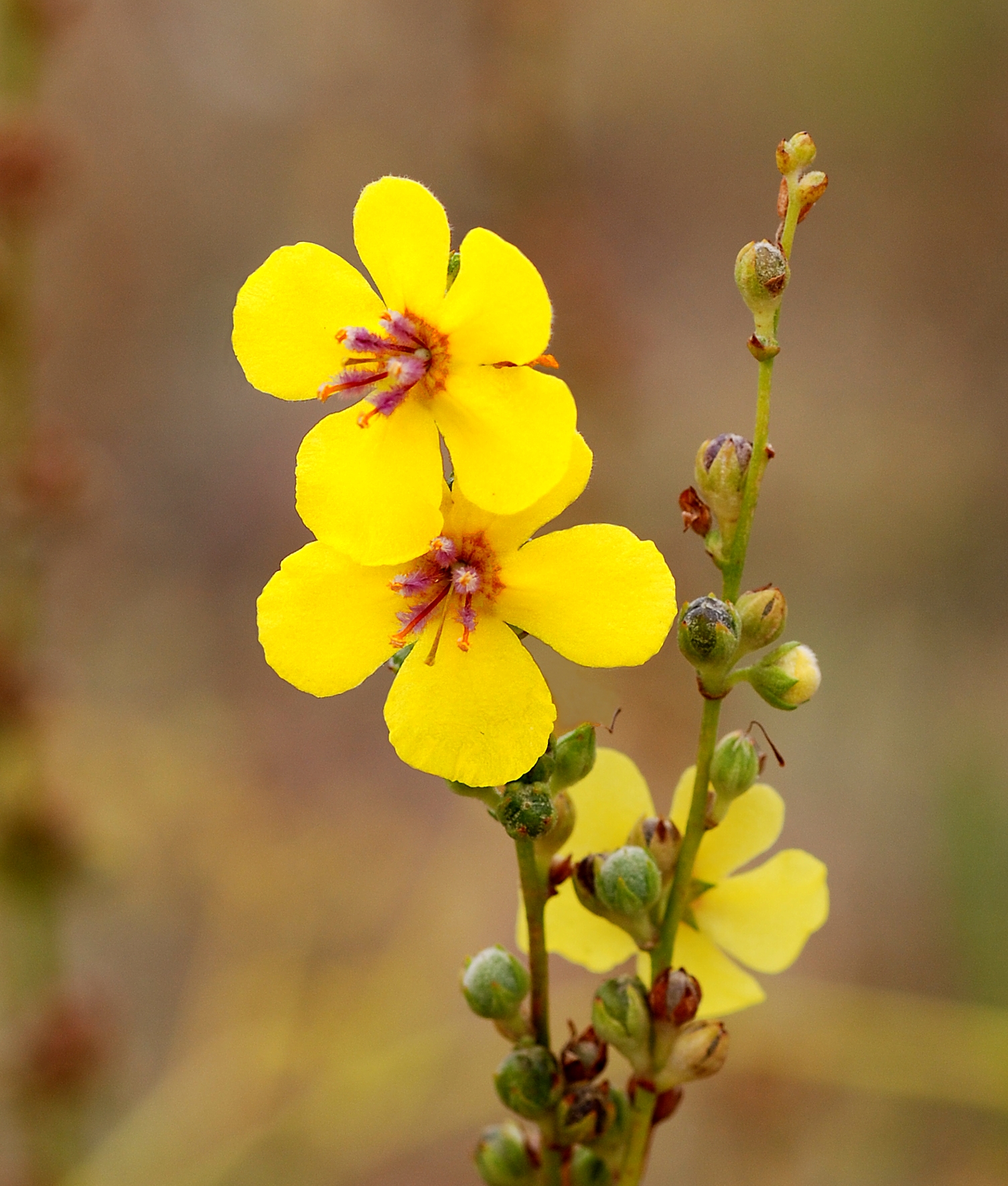
Verbascum, commonly known as mulleins, is a genus of over 450 flowering plants (POWO recognises 465 accepted species) in the family Scrophulariaceae, order Lamiales. The genus was established by Linnaeus and first published in Species Plantarum in 1753. Plants range from annuals to biennials and short-lived perennials, typically growing 0.5 to 3 metres tall.
The most recognisable feature of mulleins is their bold, two-stage growth habit: a flat, ground-level rosette of large, woolly or densely hairy leaves in the first year, followed by a tall, erect flowering spike. Leaves are spirally arranged and often covered in a soft, velvety, silver-grey indumentum. Flowers are borne in dense spikes and display five symmetrical petals, predominantly yellow but also occurring in orange, red-brown, purple, blue, or white depending on species and cultivar.
The genus is native to Europe and Asia, with peak species diversity in the Mediterranean region. The POWO native range extends from Europe to Mongolia and Sri Lanka, and from North Africa to Kenya and the Arabian Peninsula. Many species have become naturalised far beyond this range, particularly in North America and Australasia, where some are considered invasive weeds due to prolific self-seeding.
Mulleins are prized in horticulture for their architectural form and extended flowering season, performing well even in poor, dry, well-drained soils. The genus also has a long history in traditional medicine, most notably Verbascum thapsus (great mullein), whose leaves and flowers have been used in herbal preparations for respiratory ailments.
Etymology
The genus name Verbascum is derived from the Latin barbascum (bearded), a reference to the densely hairy foliage characteristic of many species. An alternative derivation links it to the Latin verbum (word), though the bearded derivation is more widely cited. The common name "mullein" comes from Old French moleine, itself traceable to the Latin mollis meaning soft, again alluding to the soft, velvety texture of the leaves.
Distribution
Verbascum is native to a broad band of the Old World, spanning from Europe east to Mongolia and Sri Lanka, and from North Africa south to Kenya and across to the Arabian Peninsula. Species diversity is highest in the Mediterranean basin and the Near East. The genus has been widely introduced beyond its native range into the Americas, Oceania, and other regions, where several species — particularly V. thapsus — have naturalised extensively and are considered invasive in parts of North America.
Within Europe, Switzerland alone supports approximately 16 documented species, including V. thapsus, V. nigrum, V. densiflorum, V. chaixii, V. lychnitis, and V. phoeniceum, illustrating the genus's density across temperate European flora.
Ecology
Mulleins occupy a wide range of open and disturbed habitats — roadsides, dry grasslands, rocky slopes, waste ground, and forest clearings — typically preferring well-drained, often nutrient-poor substrates in full sun. Their drought tolerance and ability to thrive in poor soils makes them early colonisers of disturbed ground. Some species, particularly V. thapsus, have weed potential and are classified as invasive in parts of North America due to prolific self-seeding.
The pollen-rich flowers attract a range of pollinators including bees and hummingbirds. The mullein moth (Cucullia verbasci, Lepidoptera) is a well-known specialist herbivore whose larvae feed on Verbascum leaves and flowers. Several species also function as dynamic accumulators, cycling nutrients in the habitats they colonise.
Cultivation
Mulleins are widely cultivated as ornamentals, valued for their bold, architectural form — tall flower spikes above large woolly rosettes — and their tolerance of challenging conditions. They perform best in full sun with excellent drainage and thrive in poor, dry soils; overly rich soil produces sprawling, weak-stemmed plants. They are generally drought-tolerant once established.
Four cultivars have received the Royal Horticultural Society's Award of Garden Merit: 'Gainsborough', 'Letitia', 'Pink Domino', and 'Tropic Sun'. Other popular selections include 'Snowy Spires' (white petals with purple stamens), 'Banana and Custard' (yellow), and 'Wedding Candles' (white with purple centres). Most cultivated forms are hybrids or selections within V. phoeniceum, V. chaixii, and related species.
Propagation
Mulleins are most commonly propagated from seed. Seeds should be sown in late spring to early summer, either directly or in a cold frame with minimal covering. Germination typically occurs within 2–3 weeks. Seedlings are pricked out individually once large enough to handle and transplanted to their final positions in late summer. Verbascum seeds are noted for their long viability, remaining viable in soil for many years — a factor contributing to the weedy behaviour of some species.
Root cuttings are an alternative method, particularly useful for propagating named cultivars and hybrids that do not come true from seed. Plants are generally short-lived (biennial or short-lived perennial) but self-seed freely where conditions suit them.
Cultural Uses
Verbascum thapsus (great mullein) is the species most deeply embedded in traditional medicine. Its leaves and flowers have been used in herbal preparations — as teas, infusions, and poultices — primarily for respiratory complaints including coughs, bronchitis, and congestion. Traditional Austrian medicine records both internal use (as a tea) and external use of Verbascum flowers for disorders of the respiratory tract.
Beyond medicine, some species have been employed as insect repellents; leaves of V. blattaria (moth mullein) were placed indoors to repel moths and cockroaches.
Taxonomy Notes
Verbascum L. was described by Carl Linnaeus and published in Species Plantarum in 1753. It belongs to the family Scrophulariaceae (the figwort family) within the order Lamiales. GBIF records 1,104 descendant taxa across the genus, while POWO recognises 465 accepted species.
The genus has accumulated 14 heterotypic synonyms over time, notably Blattaria Mill., Celsia L., Ditoxia Raf., Rhabdotosperma, and Staurophragma, reflecting a history of taxonomic splitting and lumping particularly in the 18th and 19th centuries. The high proportion of hybrid species (denoted by ×) within the genus points to active hybridisation and speciation. In Switzerland, approximately 16 species are formally documented in the national flora checklist.










