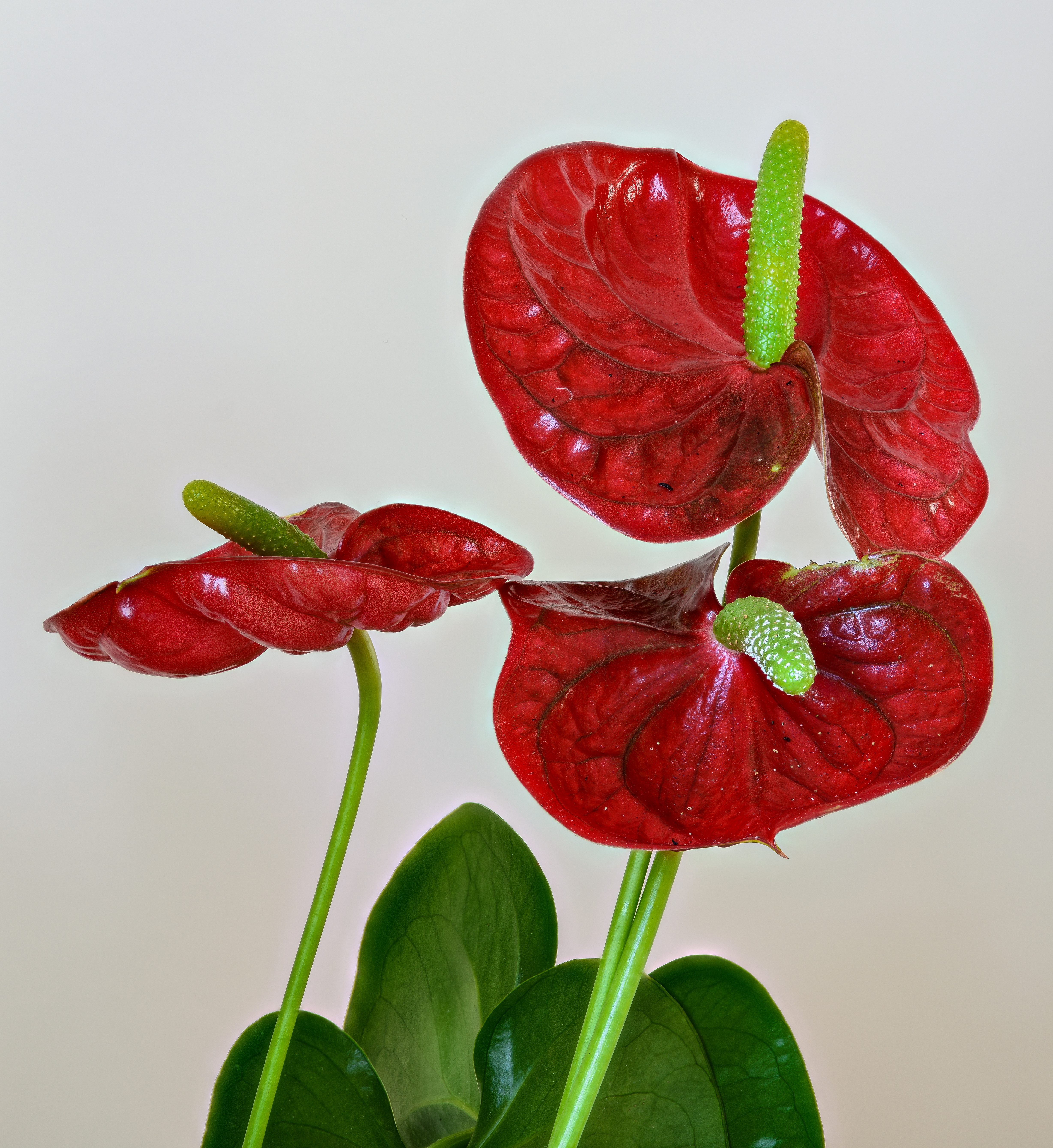
Anthurium is a large genus of tropical herbaceous perennial plants in the arum family (Araceae), comprising approximately 1,000 to over 1,300 species. Known commonly as laceleafs or flamingo flowers, these evergreen plants typically grow 30–90 cm (1–3 ft) tall and are native to the tropical Americas, ranging from northern Mexico south to northern Argentina and throughout the Caribbean.
The genus is distinguished by its characteristic inflorescence: small, perfect flowers arranged in spirals on an elongated spadix, which is accompanied by a modified leaf called a spathe. The spathe varies from lance-shaped to hood-like and, in the most popular ornamental species, takes on vivid colours including red, pink, orange, and white. The spathe and spadix stand at right angles to one another in many species, a feature noted in cultivation guides. Leaves are typically glossy, waxy, and heart-shaped, though leaf shape varies considerably across the genus. Following flowering, fruits develop as juicy berries containing around two seeds.
Many Anthurium species grow as epiphytes anchored to other vegetation rather than in soil, thriving in the moist, organic-rich substrates of tropical forests. Some species are terrestrial. The genus was formally described by the Austrian botanist Heinrich Wilhelm Schott and published in 1829 in Wiener Zeitschrift für Kunst. The type species is Anthurium acaule. Schott later revised the genus in the 1860 work Prodromus Systematis Aroidearum, defining 183 known species in 28 sections. Subsequent revisions reshaped the sections to 18 (1905) and 20 (1983).
All Anthurium species contain insoluble calcium oxalate crystals and are toxic to cats, dogs, and horses. Contact with sap can cause skin and eye irritation, and ingestion causes oral pain and swelling.
Etymology
The genus name Anthurium is derived from the Greek words anthos (flower) and oura (tail), a reference to the distinctive tail-like spadix that is characteristic of the inflorescence.
Distribution
Anthurium is native to the tropical Americas. Its range extends from northern Mexico through Central America, across South America to northern Argentina, and into the Caribbean islands. Species diversity is concentrated in the Andean regions of Colombia, Ecuador, Peru, and Venezuela. Herbarium specimens documented in the SEINet network confirm occurrence records across Antioquia and other Andean zones of Colombia, as well as Central American localities. The genus is absent from Africa, Asia, and Australasia in its native range.
Ecology
Most Anthurium species inhabit tropical and subtropical moist forest environments, where many grow as epiphytes on the branches and trunks of other plants rather than rooting in soil. This epiphytic habit allows them to access higher light levels in the forest canopy while obtaining moisture and nutrients from organic debris, rainfall, and humid air. Some species are fully terrestrial. The genus thrives in moist substrates with high organic matter content. Plants are pollinated via the spadix and produce juicy berries that are dispersed by birds and other frugivores. Anthurium species have also been noted for their capacity to improve indoor air quality when grown as houseplants.
Cultivation
Anthurium species are widely grown as houseplants and ornamental container plants. They perform best in bright, indirect light; south- or west-facing windows are suitable indoors, but direct sun scorches the leaves. Outdoors they require shade and are not cold-hardy outside tropical or subtropical climates, with an optimal temperature range of 18–29 °C (65–85 °F).
Plants prefer consistently moist, well-drained, acidic loam with good aeration. Rainwater or purified water is preferred over tap water. High humidity is essential — low humidity causes brown leaf tips. Fertilising with a high-phosphorus formula every two to four weeks and removing spent blooms encourages continued flowering. Vining species require a support structure such as a moss pole. Common pests include mealybugs, spider mites, whiteflies, scale insects, and thrips; overwatering leads to root rot.
The two most widely cultivated species are Anthurium andraeanum (flamingo lily) and A. scherzerianum (flamingo flower), both valued for their long-lasting, brilliantly coloured spathes — the only two species in the genus that naturally produce bright red spathes.
Propagation
Anthurium is propagated by stem cuttings or by seed. Stem cuttings are the more common method for houseplant production and allow growers to reproduce selected cultivars true to type. Seeds are used in breeding programs to develop new cultivar selections with novel spathe colours and forms.
Taxonomy
Anthurium Schott (1829) is the type genus of tribe Anthurieae within subfamily Pothoideae of the family Araceae, order Alismatales. The GBIF backbone taxonomy records the genus as accepted with over 2,054 descendant taxa. Recognised synonyms at genus rank include Podospadix Raf. (1838) and Strepsanthera Raf. (1838). The first major sectional revision, by Schott in his 1860 Prodromus Systematis Aroidearum, recognised 183 species in 28 sections; subsequent revisions reduced this to 18 sections (1905) and revised to 20 sections (1983). The type species is Anthurium acaule (basionym Pothos acaulis Jacq.).
History
The genus was established by the Austrian botanist Heinrich Wilhelm Schott and published in 1829 in the Wiener Zeitschrift für Kunst, Literatur, Theater und Mode. Schott was curator at the Imperial Gardens in Vienna and authored foundational treatments of the Araceae family. By 1860, 183 species had been described, which Schott organised in 28 sections in his monograph Prodromus Systematis Aroidearum. The genus was subsequently revised in 1905 (18 sections) and again in 1983 (20 sections) as new species were described from Neotropical field collections.










