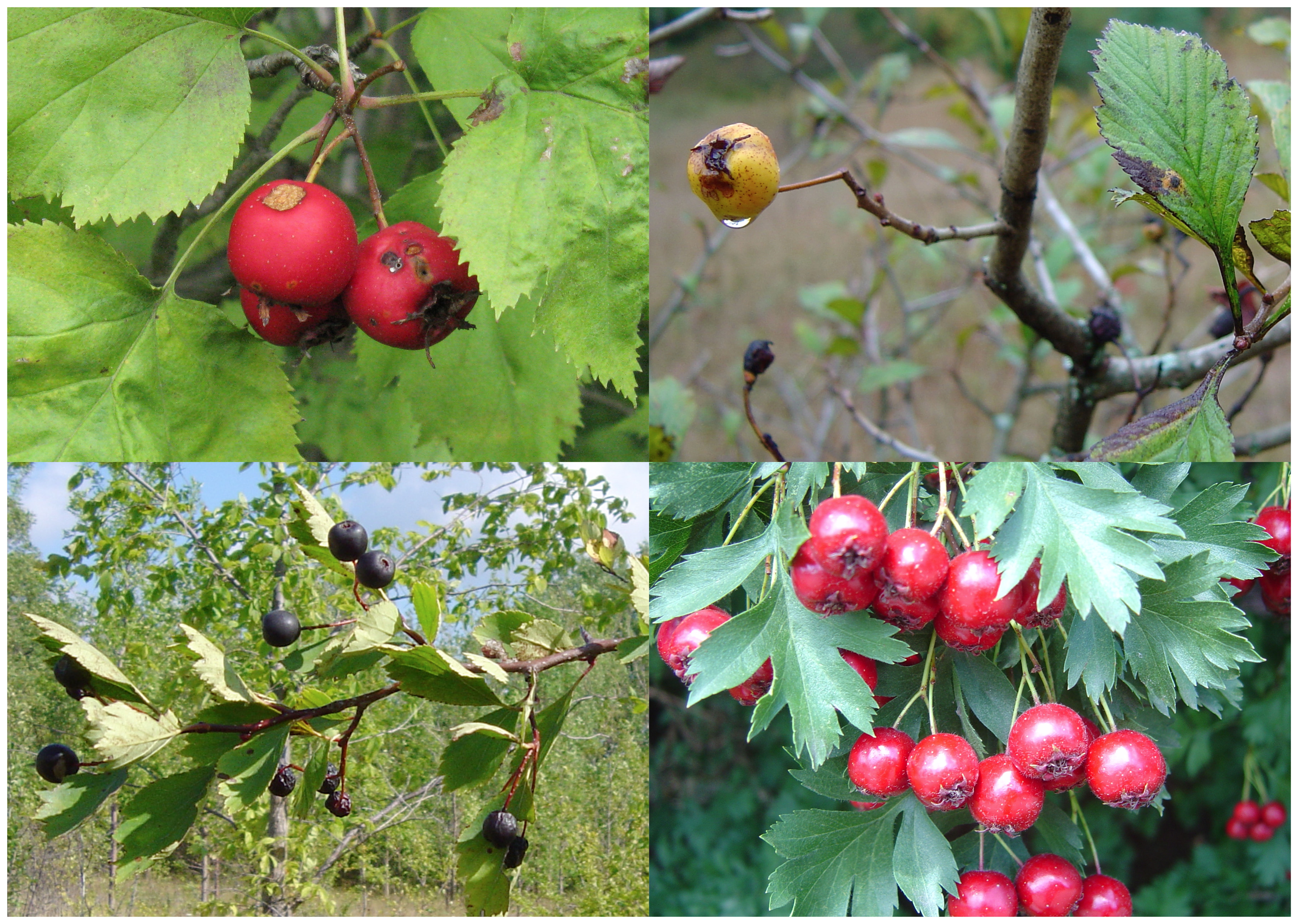
Crataegus, commonly known as hawthorn, is a genus of roughly 200 species of thorny shrubs and small trees in the rose family (Rosaceae, subfamily Amygdaloideae). Members go by many common names including quickthorn, thornapple, May-tree, whitethorn, Mayflower, and hawberry. The genus was formally described by Linnaeus in 1753 and the name traces to Greek kratos (strength, for the durable wood) and akis (sharp, for the thorns).
Hawthorns are recognizable plants: most species form multi-stemmed shrubs or small trees 5 to 15 metres tall, with smooth grey bark in youth that becomes fissured with age, and stiff, sharp thorns typically 1 to 3 centimetres long. Leaves are simple, deciduous, toothed and often deeply lobed. In spring the branches carry flat-topped corymbs of perfect, five-petalled flowers, most commonly white but occasionally pale pink or scarlet, with 5 to 25 stamens. The flowers mature into small pomes called haws — globose to ovoid or pyriform fruits, typically red, that usually contain 5 clustered seeds.
The genus is native to temperate regions of the Northern Hemisphere — Europe, North Africa, much of Asia, and North America — with the Andes forming a notable southern outlier. The fossil record places its origins in the Eocene of eastern North America and Europe. Diversity is greatest in northeastern North America, where hundreds of microspecies have been described. Crataegus is famously difficult taxonomically: hybridization, polyploidy, aneuploidy, and apomixis blur species boundaries, and historical botanists named more than a thousand apomictic microspecies before modern treatments consolidated them into roughly 200 species arranged in about 8 sections. Treatments are openly acknowledged to be tentative and a target for ongoing biosystematic study.
Hawthorns are characteristically pioneer plants of disturbed and edge habitats — pastures, forest margins, second-growth woodland, and streamside thickets — where they provide food and shelter for many birds and mammals and important nectar for insects. They have long served human uses, too: as hedging during the British Agricultural Revolution, as ornamental specimens, as rootstocks for grafting, as a source of hard, rot-resistant timber, and as the source of edible haws used for jelly, wine, and the Chinese sweets tanghulu and haw flakes. Their flowers and fruit are also a staple of traditional herbal medicine for cardiovascular complaints.
Etymology
The genus name Crataegus comes from Greek kratos, meaning "strength" — a reference to the hardness and durability of the wood — combined with akis, meaning "sharp," for the conspicuous thorns. Linnaeus formalized the genus in 1753 in Species Plantarum, attributing it to Tournefort. In English the plants are best known as hawthorn but also go by quickthorn, thornapple, May-tree, whitethorn, Mayflower, and hawberry.
Distribution
Crataegus is distributed across the temperate Northern Hemisphere, with native species in Europe, North Africa, much of Asia, and North America. Northeastern North America is the diversity hotspot, with hundreds of microspecies described from that region alone. The Andes form a notable southern outlier — one of the few extensions of the genus south of the equator. The fossil record indicates the genus originated in the Eocene of eastern North America and Europe.
Ecology
Hawthorns are pioneer plants of disturbed and seral habitats: pastures, forest edges, open second-growth woodland, and streamside thickets. All species share the same phenology — flowering in spring and fruiting in fall. The dense, thorny canopies provide nesting cover and the late-season haws are an important food source for many birds and mammals, while the flat-topped corymbs of nectar-rich flowers support a wide range of nectar-feeding insects.
Taxonomy
Crataegus is famously difficult taxonomically. Hybridization, polyploidy, aneuploidy, and widespread apomixis have produced large numbers of microspecies, and historical botanists named more than a thousand of them. Modern treatments consolidate the genus into roughly 200 species arranged in about 8 sections with further series subdivisions, but authorities openly describe these treatments as tentative and acknowledge that many recognized names likely represent hybrid or hybrid-origin plants. GBIF records 1,264 described descendant taxa under the accepted genus Crataegus L. (Sp. Pl. 475, 1753).
Cultivation
Hawthorns are easy garden plants. They are hardy across roughly USDA zones 4–8 (UK zone 5, surviving to around −18 °C), prefer well-drained loamy soil but adapt readily to clay and chalk, and tolerate moist to drought conditions. Full sun maximizes fruit production but semi-shade is acceptable. They tolerate exposed sites and atmospheric pollution, which contributes to their popularity as urban specimen trees. Historically they were planted en masse as hedging during the British Agricultural Revolution, and they remain useful as ornamental small trees, wildlife hedges, and as grafting rootstocks within Rosaceae.
Propagation
Hawthorn seed germinates slowly and erratically and benefits from a long, two-step stratification. Sowing fresh seed outdoors in a cold frame in autumn gives the best results; stored seed needs about three months of warm stratification (around 15 °C) followed by about three months of cold stratification (around 4 °C) before sowing. Seedling-grown trees typically take 5 to 8 years to fruit, while grafted trees may flower as early as their third year — one reason most named ornamental cultivars are propagated by grafting.
Cultural Uses
Hawthorns have a long history of human use. The haws are edible raw or cooked, ripening in early autumn, and have been turned into jelly, wine, and — in the case of Chinese hawthorn (C. pinnatifida) — the candied skewers known as tanghulu and the confection called haw flakes. Both flowers and fruit have a long tradition in herbal medicine as a mild cardiac tonic with hypotensive effects, taken as tea or tincture for cardiovascular complaints; a 2008 Cochrane meta-analysis is cited as supporting some of these uses. The hard, rot-resistant wood was historically used for tool handles and fence posts. Hawthorn also figures prominently in folklore: a Scottish proverb — "Ne'er cast a cloot til Mey's oot" — warns against shedding warm clothes before hawthorn blooms, and Gaelic tradition treats hawthorns as fairy gateways.
History
The fossil record places the origin of Crataegus in the Eocene of eastern North America and Europe, making it an old lineage within Rosaceae. Linnaeus formally circumscribed the genus in 1753 in Species Plantarum (page 475), attributing the name to Tournefort. The genus became central to landscape history in Britain during the Agricultural Revolution of the 18th and 19th centuries, when common hawthorn (C. monogyna) was planted as field hedging on an enormous scale, shaping the enclosed countryside still visible today.










