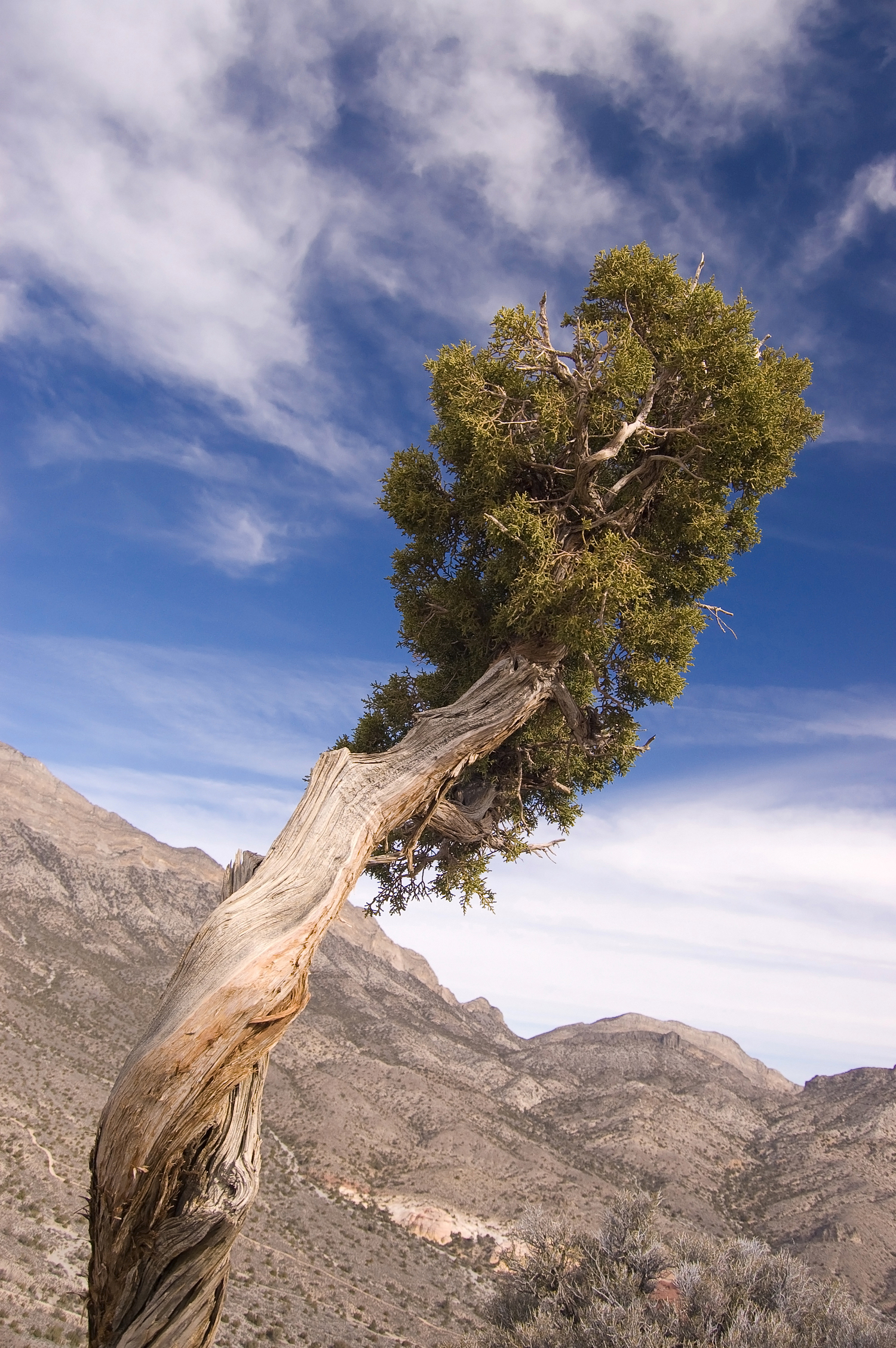
Junipers are coniferous trees and shrubs forming the genus Juniperus, the largest genus in the cypress family Cupressaceae. With 50–67 accepted species (and around 225 total taxa including infraspecific ranks according to GBIF), junipers display a remarkable range of forms — from low, prostrate ground-hugging shrubs to tall, upright trees exceeding 20 metres. They are among the most widely distributed woody plants on earth, spanning the Northern Hemisphere from Arctic tundra to subtropical zones, and extending south into tropical Africa and Central America.
Junipers are set apart from most other conifers by their fleshy, berry-like seed cones. What are commonly called "juniper berries" are technically modified cones in which the scales have fused and become fleshy, enclosing one to thirteen seeds depending on the species. Foliage varies between juvenile needle-like leaves and adult scale-like leaves, and many species carry both types simultaneously.
The genus is classified in three sections based on molecular phylogenetics. Section Caryocedrus contains a single Mediterranean species with large, woody, three-seeded cones. Section Juniperus comprises around 14 species with blue or red seed cones. Section Sabina, the largest, includes approximately 60 species with variably coloured cones and a wide range of seed counts. A 2022 classification proposed splitting the genus into Arceuthos, Sabina, and Juniperus sensu stricto, though this treatment is not yet universally adopted.
Junipers thrive in dry, rocky, and often nutrient-poor environments. They grow in open woodlands, rocky slopes, alpine zones, and semi-arid scrublands, tolerating a wide pH range and poor drainage conditions once established. The highest-known juniper forest stands at 4,900 metres in the southeastern Tibetan plateau and northern Himalayas, making it one of the highest tree lines on earth.
Etymology
The genus name Juniperus is classical Latin for the juniper plant, used by Roman authors including Virgil and Pliny. The English word "gin," the spirit flavoured with juniper berries, derives from the Dutch word jenever, itself from Latin juniperus.
Distribution
Junipers have one of the broadest natural distributions of any woody plant genus. Species occur throughout the Northern Hemisphere, from the Arctic south to tropical Africa and Central America, and across temperate and montane regions of Asia, Europe, and the Americas.
In Switzerland and adjacent alpine Europe, four species are documented: Juniperus communis (including the lowland subspecies communis and the alpine subspecies alpina), J. sabina, and J. thurifera. In North America the genus is well represented from the boreal zone south through the Rocky Mountains and into Mexico; GBIF records accepted species from arid western ranges (J. osteosperma, J. occidentalis, J. scopulorum) to the eastern seaboard (J. virginiana). Species also occur in the Caribbean (J. bermudiana, J. barbadensis), East Africa (J. procera), the Mediterranean (J. oxycedrus, J. phoenicea, J. drupacea), the Canary Islands (J. cedrus, J. canariensis), and across Central and East Asia (J. chinensis, J. recurva, J. squamata).
The highest known juniper forest grows at 4,900 metres in the southeastern Tibetan plateau and northern Himalayas, representing one of the highest tree lines recorded for any woody plant.
Ecology
Junipers are characteristically drought-tolerant and adapted to harsh, often nutrient-poor conditions. Western North American species occupy open woodlands on dry, rocky terrain with large, unshaded interspaces. The genus tolerates a wide soil pH range (approximately 4–8) and a diversity of substrates from light sandy soils to heavy clay, provided drainage is adequate.
Junipers are alternate hosts for Gymnosporangium rust fungi, which complete part of their life cycle on junipers before infecting rosaceous hosts such as apples and hawthorns; this disease relationship has management implications in mixed orcharding landscapes.
Ecologically, junipers serve as significant wildlife habitat. Several moth and butterfly species are specialist feeders on juniper foliage, completing their larval stages exclusively on this genus. Dense juniper canopy also provides cover and nesting sites for birds, and the fleshy berry-like cones are an important food source for frugivorous birds that disperse the seeds.
In western North America, juniper encroachment into sagebrush steppe and grassland is documented as an ecological concern, with expanding juniper stands altering open-habitat communities.
Cultivation
Junipers are among the most widely cultivated conifers in horticulture, valued for their diversity of form — from ground-hugging cultivars a few centimetres tall to columnar specimens several metres high — as well as their foliage colour, which ranges from green and grey-green to gold and blue in named cultivars.
They are highly adaptable in the garden: tolerant of a wide range of soil types and pH (4–8), drought-resistant once established, and generally hardy across USDA zones 4–10, with variation by species and cultivar. They perform best in full sun to light semi-shade; deep shade suppresses growth and thins foliage. Well-drained soil is a consistent requirement, as junipers are susceptible to root rot in waterlogged conditions.
Commonly grown species include J. chinensis, J. horizontalis, and J. procumbens for ground-cover and rock-garden use; J. scopulorum and J. virginiana for screening and windbreaks; and J. communis for naturalistic and wildlife gardens. The genus is also a premier subject for bonsai, particularly J. chinensis and J. procumbens, which respond well to repeated pinching and wiring.
Propagation
Junipers can be propagated by seed, cuttings, or layering, though each method requires patience. Seed germination is complicated by a double dormancy: the embryo requires a warm stratification period followed by cold stratification, each of approximately two to three months. Scarifying the seed coat before stratification (physical abrasion or brief soaking in near-boiling water) can improve germination rates. Because of this complexity, named cultivars are virtually always propagated vegetatively.
Semi-ripe to mature wood cuttings, taken in September or October with a heel of older wood attached, are the standard method. They are rooted in a cold frame and typically take several months to root reliably. Layering, also performed in autumn, takes approximately twelve months before the rooted layer can be detached.
Cultural uses
Juniper berries (the fleshy seed cones) are perhaps the most commercially significant product of the genus. They are the defining botanical flavouring of gin; the spirit's name traces directly through Dutch jenever to Latin juniperus. Berries are also used dried as a spice for game meats, pork, and charcuterie in European cuisines.
The wood of several species — notably J. virginiana (eastern redcedar) — is dense, aromatic, and highly rot-resistant. It has long been used for fence posts, closet linings, and storage chests; the distinctive scent is a natural insect repellent. Juniper wood also serves as firewood and, historically, as incense.
Ethnobotanically, indigenous peoples of the American Southwest, including the Navajo, used J. communis and related species medicinally, with documented applications for diabetes management. Scottish folkloric tradition employed juniper in saining rites — ritual purification ceremonies performed to protect people, animals, and homes.
Beyond food and timber, junipers are planted for windbreaks and erosion control in degraded landscapes, their deep roots and drought tolerance making them effective pioneers in difficult sites.
Conservation
Conservation concerns for the genus operate at two scales. At the population level, localised decline of Juniperus in regions such as the Lahaul Valley (northern India) is driven by overgrazing and direct human harvesting for fuel, construction, and fodder; these pressures are rapidly depleting juniper stands in some Himalayan communities.
At the landscape scale in western North America, the dynamic runs in the opposite direction: several native juniper species are expanding their range into sagebrush steppe, grassland, and shrubland as a result of fire suppression and altered grazing regimes. Dense juniper encroachment suppresses open-habitat plant communities and reduces biodiversity, prompting land-management programmes aimed at controlling expansion.
Individual species-level conservation assessments vary; some island-endemic species (J. bermudiana, J. brevifolia) have restricted ranges and are considered at risk.
Taxonomy notes
Juniperus L. was formally described by Carl Linnaeus in Species Plantarum: 1038 (1753), making it one of the earlier conifer genera formally named in the Linnaean system. It belongs to the family Cupressaceae, within the order Pinales, class Pinopsida.
Molecular phylogenetic studies have clarified the internal structure of the genus, recognizing three sections: section Caryocedrus (one Mediterranean species), section Juniperus (approximately 14 species with blue or red berry-like cones), and section Sabina (roughly 60 species, the most diverse, with cones containing 1–13 seeds). Wikipedia cites 72 accepted species while GBIF records 225 total descendant taxa including infraspecific ranks.
A 2022 treatment proposed elevating the three sections to genus rank — Arceuthos, Sabina, and Juniperus sensu stricto — but this circumscription is not universally followed in major databases. InfoFlora (Switzerland) retains the broad Juniperus concept in its national checklist.










