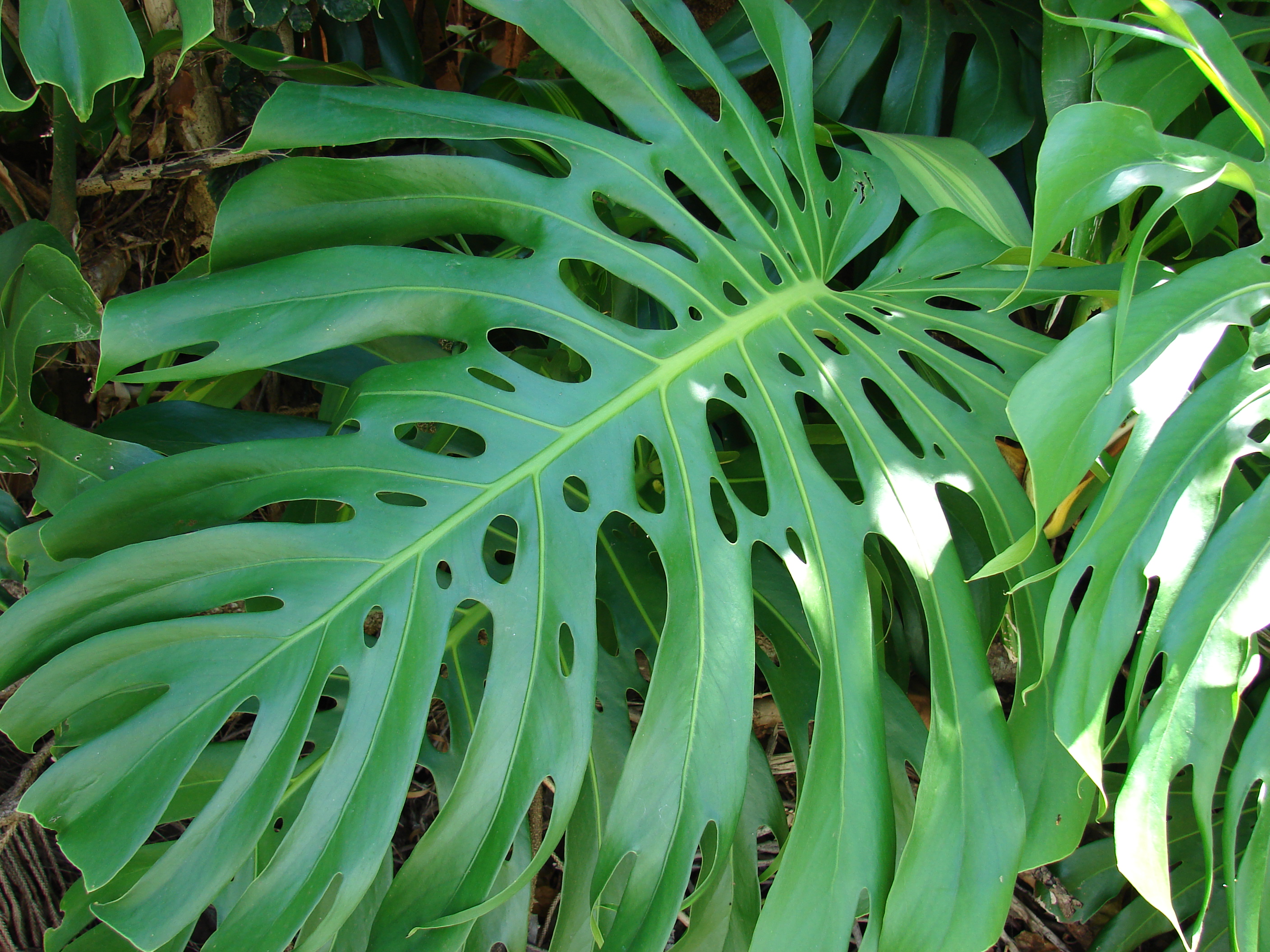
Monstera is a genus of approximately 50–70 accepted species of evergreen hemiepiphytic vines in the family Araceae (arum family), order Alismatales. The genus was formally described by the French botanist Michel Adanson in 1763 in his work Familles des plantes (Fam. Pl. 2: 470). The name derives from the Latin word for "monstrous" or "abnormal," an allusion to the genus's most distinctive feature: leaves perforated with natural holes (fenestrations) and splits that give them a striking, unusual appearance.
Native to the tropical rainforests of Central and South America — ranging from southern Mexico through Panama, Colombia, and into parts of South America — Monstera species are adapted to life in humid, shaded forest understories. As hemiepiphytes, they begin life in the soil or as seedlings that climb toward light, anchoring themselves to host trees with two distinct types of aerial roots: anchor roots that grip bark, and longer downward-growing roots that can extend up to 30 m and reach into the soil for moisture and nutrients. Mature plants can climb 20 m or more into the forest canopy.
The large, leathery, deep-green leaves are the genus's signature. In many species, fenestrations develop as the plant matures, and their function is widely thought to allow dappled light to reach lower leaves and to reduce wind resistance in exposed canopy positions. Flowers are produced on a spadix inflorescence, and in certain species — most notably Monstera deliciosa — the resulting fruit is edible, combining the flavors of banana and pineapple. All parts of the plant contain calcium oxalate crystals, which cause irritation when the plant is unripe or raw; only fully ripe fruit is safe to eat without preparation.
Monstera is among the most popular ornamental houseplant genera in the world. Species tolerate a wide range of indoor light conditions and are valued for their dramatic foliage. In cultivation they prefer bright indirect light, well-draining organic substrates, moderate and consistent watering, temperatures of 18–29 °C, and high ambient humidity. A climbing support such as a moss pole encourages the production of larger, more mature leaves. Stem cuttings taken at a node root readily in water or potting mix, making propagation accessible to home gardeners.
Etymology
The genus name Monstera is derived from the Latin monstrum, meaning "monster," "monstrous," or "abnormal." The name refers to the unusually perforated and deeply split leaves that characterize many species in the genus — leaves dotted with natural holes (perforations) and irregular slits (fenestrations) that were considered bizarre or unnatural in appearance by early European botanists. Michel Adanson, who formally established the genus in 1763, chose this evocative name to capture what set these plants apart from all others known at the time.
Distribution
Monstera is native to the tropical regions of Central and South America. The best-documented species, M. deliciosa, has a natural range spanning southern Mexico, Guatemala, Honduras, Nicaragua, Costa Rica, and Panama. The broader genus extends into Colombia and other parts of northwestern and central South America. In their native range, Monstera species occur primarily in moist to wet tropical and subtropical forest, from lowland rainforest up to montane forest at elevations of approximately 900–1,500 m. Several species have been introduced far beyond their native range as ornamental plants and, in warm tropical climates, have naturalized and can spread aggressively.
Ecology
Monstera species are evergreen hemiepiphytes: plants that possess both a soil-rooting system and an epiphytic aerial phase. They produce two functionally distinct types of aerial roots — anchor roots that clasp the bark of host trees for structural support, and long, downward-growing roots (sometimes extending 30 m) that penetrate the soil to absorb water and nutrients. This dual root strategy allows Monstera to colonize and ascend forest trees, reaching heights of 20 m or more in the canopy.
The fenestrated leaves that define many species are thought to serve adaptive functions. One widely cited hypothesis is that the holes and splits allow light to pass through to lower leaves, increasing overall photosynthetic efficiency in the dappled light of the forest understory. Another hypothesis is that the openings reduce resistance to wind and rain in the upper canopy. Leaves are alternate, leathery, and dark green, typically ranging from 25–90 cm long, though some species such as M. gigas produce leaves up to 300 cm.
Monstera species produce flowers on a spadix inflorescence. In fruiting species, the berries develop into a compound fruit spike. The fruit of M. deliciosa is edible when fully ripe, but all plant parts contain calcium oxalate crystals that cause oral irritation if consumed unripe or raw.
Cultivation
Monstera species are well-suited to indoor cultivation and have become among the most widely grown houseplant genera globally. They perform best in bright, indirect light that mimics the dappled illumination of a tropical forest floor, though they tolerate lower light levels. Direct, intense sunlight can scorch the leaves.
A well-draining, aerated growing substrate is important — a mix incorporating peat or coco coir, perlite, and coarse bark replicates the loose, organic soils of their native habitat. Watering should be moderate: the upper portion of the substrate is allowed to dry between waterings to prevent root rot. Temperatures between 18–29 °C suit most species; they can tolerate brief excursions to -3 °C (particularly M. deliciosa) but growth stalls below approximately 18 °C. High humidity promotes faster growth and larger, more fully fenestrated leaves.
Providing a climbing support — a moss pole, coir totem, or trellis — encourages upward growth and the development of larger, more mature foliage. Regular pruning of leggy stems redirects energy to new growth. In frost-free outdoor climates with sufficient rainfall (1,000–2,500 mm annually), Monstera can be grown in the garden; M. deliciosa in particular can become invasive in tropical and subtropical regions outside its native range.
Propagation
Monstera is easily propagated by several vegetative methods. Stem cuttings taken just below a node — including at least one leaf — root readily when placed in water or a moist potting medium. Internodal cuttings and tip cuttings with a single leaf attached are both effective. Air layering is another reliable approach, particularly for large established plants where removing a stem cutting would be impractical.
Seed propagation is possible; seeds must be kept consistently moist as they lose viability rapidly when dried. Plants grown from seed typically take 6–8 years to reach flowering and fruiting maturity, while vegetatively propagated plants (from cuttings) may flower and fruit within 3–4 years. In suitable conditions, mature plants flower and fruit year-round.
Cultural Uses
The edible fruit of Monstera deliciosa is the genus's most significant food use. Known as ceriman or Mexican breadfruit, the ripe fruit tastes of a combination of banana and pineapple and can be eaten fresh or processed into jellies, jams, ice cream, and beverages. Only fully ripe fruit is safe to consume raw — calcium oxalate crystals in unripe fruit cause intense mouth and throat irritation. These crystals break down upon complete ripening, thorough cooking, or full drying.
Beyond food, the genus has practical craft uses in Central America. The long, fibrous aerial roots of Monstera deliciosa have traditionally been used in Guatemala to weave and construct mimbre-style furniture and basketry. More broadly, Monstera — particularly M. deliciosa and M. adansonii — are among the most ubiquitous ornamental houseplants in the world, valued for their dramatic fenestrated foliage and adaptability to indoor conditions.
Taxonomy
The genus Monstera Adans. was formally published in Familles des plantes (Fam. Pl. 2: 470) in 1763 by the French naturalist Michel Adanson. It belongs to the family Araceae, order Alismatales, class Liliopsida, phylum Tracheophyta, kingdom Plantae. Published synonyms include Tornelia Gutierrez ex Schott and Serangium Wood ex Salisb. Species counts vary by authority: the Wikipedia article cites 64 accepted species and 6 infraspecific names as of November 2022, while the GBIF backbone records 95 names (including synonyms) under the genus.










